
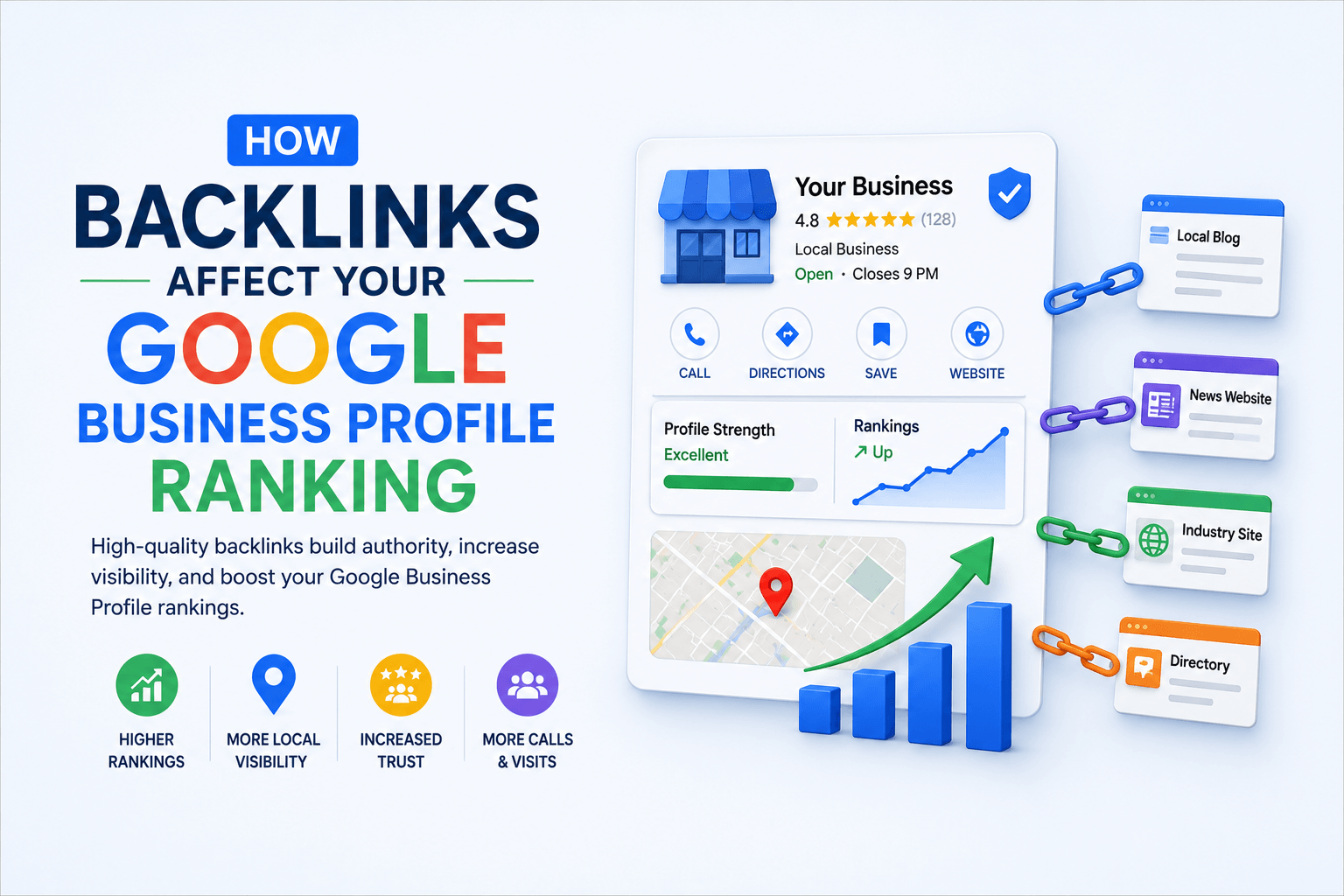
Backlinks local SEO GBP is one of the most misunderstood ranking levers in local search — and one of the most underused by small businesses competing in the local pack. Most local business owners pour energy into optimizing their Google Business Profile: updating categories, collecting reviews, posting consistently. All of that matters. But Google does not evaluate your GBP in isolation. It evaluates your entire web presence, and the external link signals pointing at your website and your business entity are a core part of that evaluation.
This post unpacks exactly how backlinks influence local SEO rankings, where the GBP fits into that equation, and what practical link-building actions move the needle for local businesses competing in map pack results. If you have already covered local keyword research and have your Google Business Profile fully optimized, this is the off-page layer that ties everything together.
Does Google Use Backlinks to Rank Google Business Profile Listings?
The short answer is yes — but the relationship is indirect and frequently misunderstood. Google’s local ranking algorithm has three publicly confirmed primary factors: relevance, distance, and prominence. Backlinks contribute primarily to prominence — Google’s measure of how well-known and authoritative your business is on the web.
Google’s own documentation on how local results are ranked states that prominence is informed by information Google has about a business from across the web — including links, articles, and directories. This is a direct acknowledgment that external link signals factor into map pack positioning.
However, there is a critical distinction between how backlinks affect organic web results and how they affect GBP rankings. For organic rankings, backlinks are among the top three ranking signals. For local pack rankings, the weighting is different — proximity and relevance often dominate for hyper-local queries. But at a competitive level, where proximity is equal between two businesses, off-page authority consistently becomes the deciding factor.
| Key Insight: When your GBP listing and your website share the same NAP (Name, Address, Phone) data and are entity-linked in Google’s Knowledge Graph, link equity flowing to your website strengthens your overall entity authority — which in turn lifts your local pack visibility. |
If you want to optimize your Google My Business (GMB) Profile and want to get back your deserve sale
Let’s connect.
Click a button below to talk or chat with us
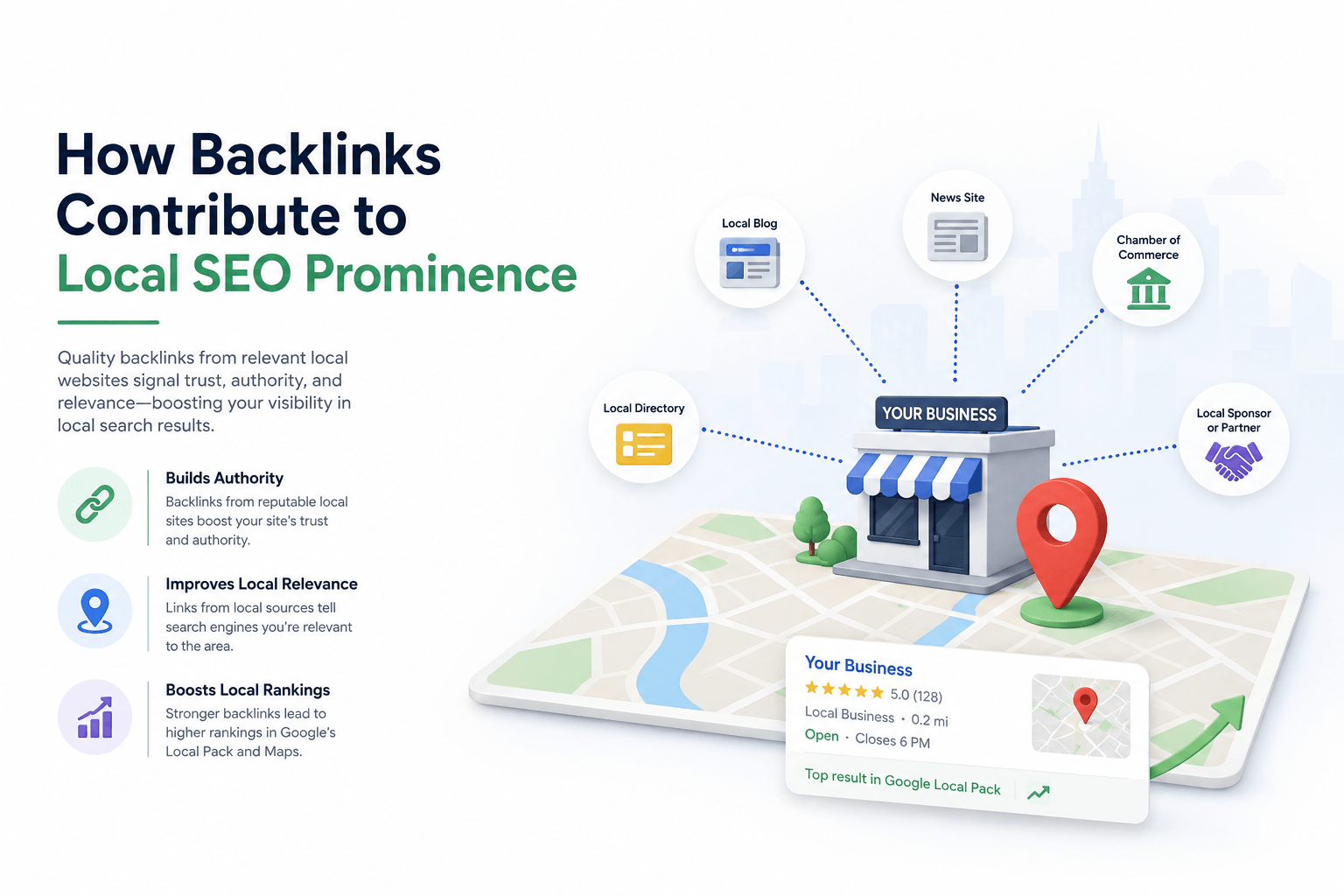
How Backlinks Contribute to Local SEO Prominence
Understanding the mechanism helps you build links strategically rather than randomly. Here is how link signals feed into local ranking prominence:
1. Domain Authority and Trust Flow
When high-authority domains link to your website, they pass link equity (sometimes called PageRank or link juice) to your pages. This raises your site’s overall domain authority — a proxy metric tracked by tools like Moz Domain Authority (DA) and Ahrefs Domain Rating (DR). Google’s internal systems use similar authority calculations, and a higher-authority website attached to your GBP entity signals to Google that your business is a recognized, credible player in its market.
Tools like Moz’s Link Explorer let you benchmark your domain authority against local competitors. If your DA is 14 and your primary competitor’s is 28, their off-page authority advantage is likely contributing to their local pack dominance.
2. Referring Domains and Topical Relevance
The number of unique referring domains — distinct websites linking to you — matters more than the raw number of backlinks. Fifty links from three domains is weaker than fifteen links from fifteen different domains. Google weights link diversity because it reflects genuine endorsement across the web.
Equally important is topical relevance. A link from a local business association, a regional news outlet, or a niche industry directory sends a stronger local relevance signal than a generic link from an unrelated national site. Google’s entity understanding means it evaluates whether your link profile makes sense for the type of business you are and the geography you serve.
3. Anchor Text and Entity Signals
Anchor text — the clickable text used in a hyperlink — reinforces topical and geographic relevance. Natural anchor text variation including branded terms (your business name), geo-modified terms (plumber in Austin), and generic terms (website, learn more) signals an organic link profile. Over-optimized exact-match anchor text is a negative signal that can trigger algorithmic filtering. For local SEO, branded and geo-modified anchors carry the most value.
Local Citations vs. Backlinks: Understanding the Difference
Many local business owners conflate citations and backlinks. They are related but distinct signals, and a complete local SEO off-page strategy requires both.
| Signal Type | What It Is | Primary Value | Tools to Manage |
| Local Citation | Mention of NAP data on directories, maps, review platforms | Consistency, trustworthiness of business data | BrightLocal, Whitespark, Yext |
| Backlink | Hyperlink from an external domain to your website | Domain authority, link equity, prominence | Moz, Ahrefs, Google Search Console |
| Citation + Backlink | NAP mention with a live link to your site (e.g., directory listings) | Both trust and authority signals combined | BrightLocal, Moz Local |
| Unlinked Brand Mention | Business name referenced on web without a hyperlink | Entity recognition in Google’s Knowledge Graph | Google Alerts, Mention.com |
NAP consistency across all citation sources is foundational. If your business name, address, or phone number varies between your GBP, your website, and your directory listings, Google’s confidence in your business entity weakens — which suppresses prominence. Citations from high-authority local data aggregators like Foursquare, Data Axle, and Neustar Localeze feed into Google’s business data ecosystem and serve as trust anchors.
For a deeper look at how GBP citation strategy works in practice, see this guide on local SEO for small businesses and the detailed breakdown in Search Engine Optimization: How Websites Rank on Google — both provide foundational context for the off-page concepts covered here.
Link Building Strategies That Directly Lift Local Pack Rankings
Not all link-building tactics are equally effective for local SEO. The following strategies are ranked by their relevance signal to local ranking — combining authority, topical fit, and geographic specificity.
1. Local Business Associations and Chambers of Commerce
Membership links from your city’s Chamber of Commerce, Business Improvement District (BID), or regional trade association are among the most powerful local links available. These domains carry strong local topical authority, include NAP data, and are trusted by Google as authentic regional endorsements.
2. Sponsorships and Community Links
Local event sponsorships, school donations, nonprofit partnerships, and community involvement consistently generate editorial links from .org and .edu domains — domains with naturally high trust scores. These links are editorially given (not paid placements) and signal genuine community standing, which aligns directly with Google’s prominence signals.
3. Local News and Regional Media Coverage
A link from a regional newspaper, a local online news publication, or a local TV station website carries substantial domain authority and geographic relevance. Digital PR — pitching local angle stories, data-driven releases, or community commentary to regional journalists — is one of the highest ROI link acquisition strategies for local businesses.
4. Niche Industry Directories
General directories (Yelp, Yellow Pages) provide citation value but limited link equity. Niche directories — a dentist listed on the American Dental Association member directory, a contractor listed on a state licensing board — pass stronger topical relevance signals because they contextualize your business within a recognized industry category.
5. Guest Content on Local Blogs and Regional Publications
Contributing expert content to locally-read blogs, regional business publications, or industry sites with a local readership generates contextual backlinks. These links carry editorial weight — the host site has chosen to publish your content — and are surrounded by topically relevant text, which strengthens the contextual relevance signal Google extracts from the linking page.
6. Unlinked Brand Mention Reclamation
Use Google Alerts or tools like Mention to identify web pages that reference your business name without linking to your site. Outreach to these publishers requesting a link conversion is one of the lowest-effort, highest-conversion link acquisition tactics — they already know your brand enough to mention it.
How to Audit Your Current Backlink Profile for Local SEO
Before building new links, audit what you already have. A backlink audit reveals toxic links harming your authority, gaps in local relevance, and quick wins from existing relationships.
| Audit Step | What to Check | Recommended Tool |
| 1. Total Referring Domains | Number of unique domains linking to your site | Ahrefs Site Explorer, Moz Link Explorer |
| 2. Domain Authority Distribution | What DA/DR range are your linking domains in? | Moz, Ahrefs |
| 3. Local Relevance Score | Are any links from local/regional domains? | Manual review in Ahrefs |
| 4. NAP Citation Consistency | Do all directory listings match your GBP NAP exactly? | BrightLocal Audit, Moz Local |
| 5. Toxic Link Detection | Spammy, irrelevant, or low-quality links flagged | Google Search Console Disavow, SEMrush Toxic Score |
| 6. Competitor Link Gap | What links do top-ranked local competitors have that you do not? | Ahrefs Link Intersect, Moz Link Opportunities |
| 7. Anchor Text Distribution | Is your anchor text natural and varied? | Ahrefs Anchors Report |
Google Search Central provides guidance on understanding your site’s links in Search Console — which gives you a free first-party view of which domains Google has discovered linking to your site. This is the most authoritative data source for backlink auditing because it reflects what Google has actually crawled and attributed.
Common Link-Building Mistakes That Hurt Local SEO
Local businesses make predictable link-building mistakes. Here are the most damaging and how to avoid them:
- Buying links from PBNs or link farms: Paid link schemes violate Google’s spam policies and can trigger manual penalties that remove your site from local results entirely.
- Over-optimized anchor text: Stuffing exact-match geo phrases like “best plumber Austin Texas” into every anchor text looks manipulative. Google expects varied, natural anchors.
- Ignoring local relevance: Acquiring high-DA links from irrelevant national sites does less for local pack rankings than a lower-DA link from a locally trusted domain.
- Neglecting citation cleanup before link building: Inconsistent NAP data across citations undermines the entity trust that backlinks are meant to amplify.
- Building links to the homepage only: Distribute link equity across service pages, location pages, and pillar content — not just the homepage.
- Prioritizing volume over quality: Ten links from authoritative, relevant domains outperform 500 links from low-quality directories.
Building a Local Link Acquisition System: A Practical Framework
Sustainable local link building is a system, not a one-time campaign. Here is a repeatable monthly framework:
| Month | Focus Area | Target Links | Expected Outcome |
| Month 1 | Citation audit + NAP cleanup | Fix all existing citations | Entity trust baseline |
| Month 2 | Local directories + Chamber of Commerce | 3–5 local business listings | Core local link foundation |
| Month 3 | Sponsorships + community events | 1–2 community links | Trust and prominence lift |
| Month 4 | Digital PR — local media outreach | 1–2 regional news/blog links | Authority signal boost |
| Month 5 | Niche directory submissions | 2–3 industry-specific links | Topical relevance reinforcement |
| Month 6 | Guest content + unlinked mention reclamation | 2–3 contextual editorial links | Sustained authority growth |
The key principle is compounding. Each month’s links add to a cumulative authority profile that makes the next link easier to acquire because your site becomes a more credible linking destination. For a broader understanding of how content and SEO systems work together, see Content Marketing Strategy: How to Create Content That Ranks and Converts and On-Page SEO Checklist: Optimize Every Blog Post for Google — both inform how your on-page and off-page signals work in tandem.
Measuring the Impact of Backlinks on GBP Rankings
Attribution in local SEO is imprecise, but you can track directional progress with these metrics:
- Local pack position tracking: Use tools like BrightLocal or Local Falcon to track your GBP ranking across your service area on target keywords.
- Domain authority trend: Monitor your Moz DA or Ahrefs DR monthly. Consistent upward trend confirms your link acquisition is working.
- Referring domain count: Total unique domains linking to you should grow month-over-month at a sustainable pace.
- Google Search Console clicks and impressions: Watch for increases in organic impressions and clicks from local queries — a downstream effect of authority growth.
- GBP Insights — Direction requests and calls: Increased actions in your GBP Insights dashboard indicate improving visibility, not just rankings.
Off-Page Local SEO Optimization Checklist
| Task | Status | Priority |
| Audit current backlink profile in GSC + Moz/Ahrefs | To-Do | High |
| Verify NAP consistency across all citations and GBP | To-Do | High |
| Submit to Chamber of Commerce and local business associations | To-Do | High |
| Identify and reclaim unlinked brand mentions | To-Do | High |
| Submit to niche industry directories relevant to your business | To-Do | Medium |
| Develop local digital PR strategy (story angles, media list) | To-Do | Medium |
| Plan 1 community sponsorship or partnership per quarter | To-Do | Medium |
| Set up competitor link gap analysis in Ahrefs/Moz | To-Do | Medium |
| Review and diversify anchor text distribution | To-Do | Low |
| Disavow toxic links identified in GSC or SEMrush audit | To-Do | Low |
Frequently Asked Questions: Backlinks, Local SEO & GBP
Q1: Do backlinks directly affect Google Business Profile rankings?
Not directly — GBP rankings are determined by relevance, distance, and prominence. Backlinks contribute to prominence by raising your website’s domain authority and the overall online recognition of your business entity. Strong link signals strengthen the entity trust that feeds into GBP ranking prominence.
Q2: How many backlinks do I need to rank in the local pack?
There is no fixed number. What matters is having more authoritative, locally relevant links than your direct competitors. Benchmark your referring domain count and domain authority against the top 3 local pack results for your target keywords — that gap defines your link-building priority.
Q3: Are local citations the same as backlinks?
No. Citations are mentions of your NAP data across directories and platforms — they may or may not include a live hyperlink. Backlinks are live hyperlinks passing link equity. Citations build entity trust and NAP consistency; backlinks build domain authority. A complete off-page strategy requires both.
Q4: Which types of backlinks are most valuable for local SEO?
Local business association links, regional media coverage, community sponsorship links, and niche industry directory links carry the highest value for local pack rankings. These combine domain authority with geographic and topical relevance — the combination that matters most for local prominence.
Q5: Can bad backlinks hurt my GBP ranking?
Toxic backlinks can suppress your website’s authority and potentially trigger Google penalties that harm both your organic and local pack visibility. Run regular backlink audits and use Google Search Console’s Disavow tool to neutralize harmful links from spammy, irrelevant, or manipulative domains.
Q6: How long does it take for backlinks to improve local SEO rankings?
Typically 2 to 6 months, depending on your starting authority baseline, the quality of links acquired, and the competitiveness of your local market. Links from high-authority, locally relevant domains tend to show ranking impact faster than generic directory submissions.
Q7: Should I build backlinks to my website or directly to my GBP?
Build links to your website. Your GBP does not accept external links as a direct ranking mechanism the same way web pages do. The connection between your website authority and your GBP ranking runs through entity association — Google links your GBP and your website together as representations of the same business entity, so website authority lifts GBP prominence.

No responses yet