
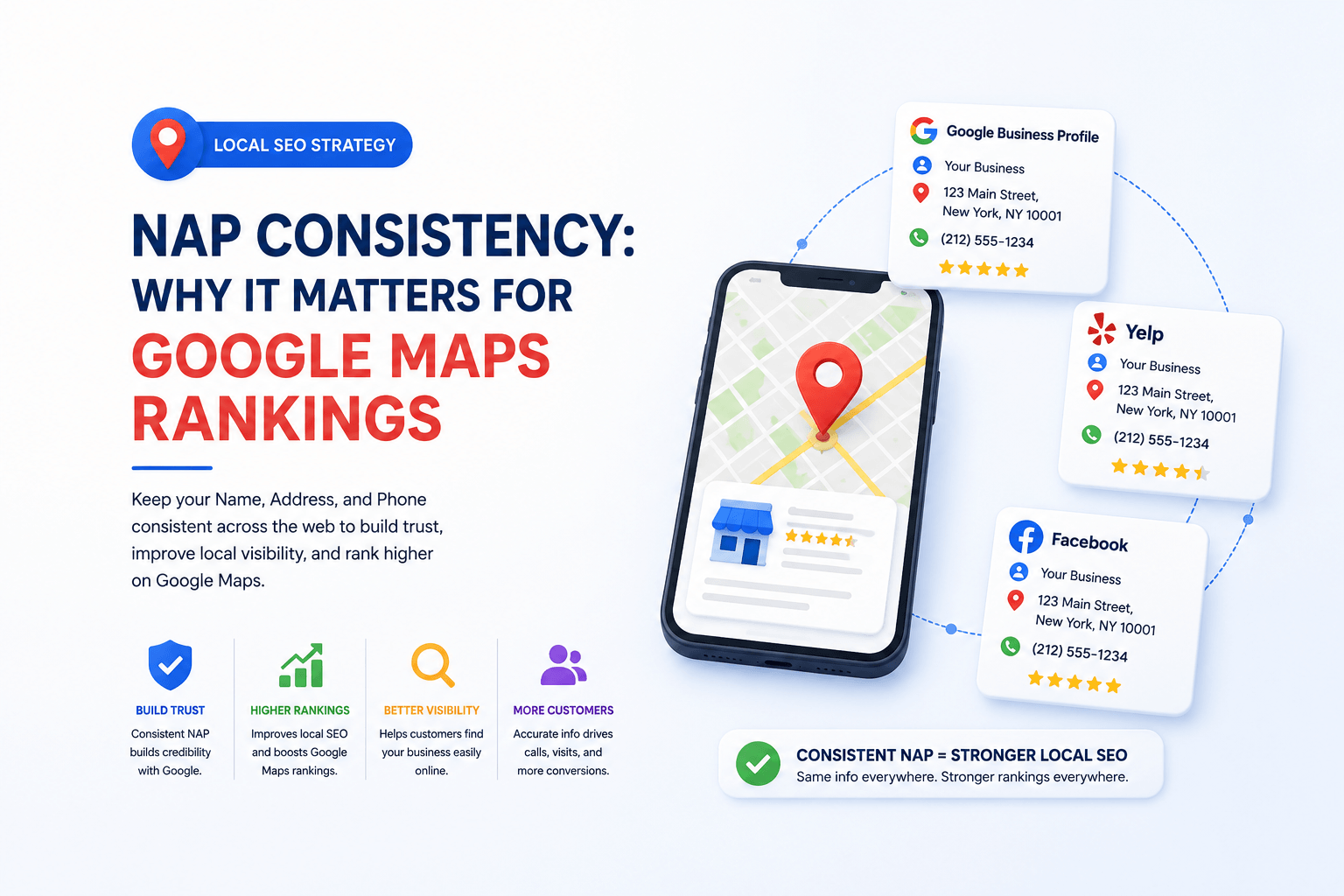
NAP consistency SEO is one of the most misunderstood and most punished ranking factors in local search. Your business might have a fully optimized Google Business Profile, a fast website, and dozens of five-star reviews — and still sit buried below competitors in the local pack because your name, address, or phone number appears differently across citation sources. Google cannot confidently rank what it cannot confidently verify. When your NAP data is inconsistent across the web, Google’s trust in your listing drops — and so does your visibility on Google Maps.
This guide breaks down exactly what NAP consistency means in the context of local SEO, why it carries significant weight in Google’s local ranking algorithm, what types of inconsistencies cause the most damage, and — most importantly — a practical step-by-step audit and correction process you can execute today.
What NAP Means in Local SEO (And Why It Extends Beyond the Basics)
NAP stands for Name, Address, and Phone Number. In local SEO, these three data points serve as the primary identity signals that connect your business across the fragmented ecosystem of online directories, data aggregators, citation sources, and mapping platforms.
If you want to know how to defeat the competitor and want to optimise your Google My Business Profile?
Let’s connect with an expert.
Click a button below to talk or chat with us
When Google crawls the web and encounters your business mentioned on Yelp, the Better Business Bureau, a local Chamber of Commerce site, or a news article — it compares that data against what you’ve listed in your Google Business Profile. If there are discrepancies, Google is forced to make a judgment call: which version is accurate? Faced with conflicting signals, the algorithm defaults to lower confidence, which typically results in lower local rankings.
The Full Scope of NAP: What Actually Counts
Most businesses understand the three letters. Fewer understand how granular the consistency requirement actually is. NAP for local SEO includes:
- Business name: Exact legal name vs. shortened name vs. DBA (Doing Business As)
- Street address: “Street” vs. “St.” vs. “St” — all treated as different by data parsers
- Suite/unit numbers: Presence vs. absence, “Suite” vs. “#” vs. “Ste.” format differences
- City, State, ZIP: Abbreviation inconsistencies (“TX” vs. “Texas”), ZIP+4 vs. ZIP5
- Phone number format: “(555) 123-4567” vs. “555-123-4567” vs. “+15551234567”
- Website URL: “https://example.com” vs. “example.com” vs. “www.example.com”
Many practitioners now use the extended acronym NAP+W (Name, Address, Phone + Website) to reflect the reality that your website URL has become equally important for citation consistency in modern local SEO.
How NAP Inconsistency Damages Your Google Maps Rankings
The local ranking algorithm at Google evaluates three primary pillars: relevance, distance, and prominence. NAP consistency directly impacts prominence — specifically, the quality and trustworthiness of your citation profile.
Google’s official local ranking documentation confirms that citation consistency is a factor in how prominently a business appears in local search results. When citations are consistent, they compound your prominence signal. When they conflict, they dilute it.
The Three Core Damage Mechanisms
1. Diluted authority signals: Each mention of your business online is a citation — a vote of confidence for your entity. If “ABC Plumbing,” “ABC Plumbing Co.,” and “ABC Plumbing Services” all appear across different directories, Google may interpret these as three separate businesses rather than one. The authority that should aggregate to one entity gets fragmented.
2. Reduced crawl confidence: Googlebot regularly crawls citation sources. When it encounters conflicting NAP data, its ability to confidently associate external mentions with your GBP listing decreases. This directly reduces the strength of your citation signals.
3. Poor user experience signals: When users call the wrong number or show up at the wrong address because of an outdated citation, negative signals (high bounce rates from directory pages, failed map navigation attempts) can indirectly influence trust metrics. More importantly, a customer who couldn’t reach you will not leave a positive review.
Common NAP Inconsistencies by Category
| NAP Element | Correct Version | Inconsistent Version | Impact |
| Business Name | Bright Digital LLC | Bright Digital / BrightDigital | Medium |
| Street Address | 123 Main Street Suite 4 | 123 Main St. #4 / 123 Main Street | High |
| Phone Number | +1 (555) 123-4567 | 555.123.4567 / 15551234567 | High |
| City/State | Austin, TX 78701 | Austin Texas / Austin TX | Low–Medium |
| Website URL | https://brightdigital.com | brightdigital.com / www.brightdigital.com | Medium |
How the Citation Ecosystem Works (And Why It Matters for NAP Audits)
Before you can fix NAP inconsistencies, you need to understand where they come from. The citation ecosystem operates on a tiered structure, and data flows in both directions — outward from aggregators and inward from user-submitted listings.
Data Aggregators: The Root of Most NAP Problems
A small number of major data aggregators push business information to hundreds of downstream directories and platforms. In the United States, the primary aggregators include Data Axle (formerly Infogroup), Neustar Localeze, and Foursquare. If your NAP is incorrect at the aggregator level, that incorrect data gets syndicated across the entire directory ecosystem — often automatically and without your knowledge.
This is why fixing your Google Business Profile alone does not fix your local rankings. The aggregators continue pushing the wrong data to hundreds of sites, overwriting corrections you make manually at the directory level.
Citation Platform Tiers and Audit Priority
| Platform Tier | Examples | Priority |
| Tier 1 – Core Directories | Google Business Profile, Apple Maps, Bing Places | Critical |
| Tier 2 – Data Aggregators | Data Axle, Localeze, Neustar/Localeze, Foursquare | High |
| Tier 3 – Niche Directories | Yelp, BBB, Angi, Houzz, Healthgrades (industry-specific) | High |
| Tier 4 – General Directories | Yellow Pages, Manta, Superpages, Citysearch | Medium |
| Tier 5 – Local/Community | Local Chamber of Commerce, newspapers, city portals | Medium |
| Tier 6 – Social Profiles | Facebook, LinkedIn, Twitter/X, Instagram bio | Low–Medium |
Understanding this tier structure is essential when building your audit process. Always fix Tier 1 first, then push corrections to Tier 2 aggregators. The Tier 3–6 corrections will often self-update over time once aggregator data is corrected, though manual verification remains the most reliable approach.
The NAP Consistency Audit: A Step-by-Step Process
A proper NAP audit is a systematic comparison of your actual business information against every published citation across the web. Here is the complete process, from establishing your canonical NAP to executing fixes at scale.
Step 1: Establish Your Canonical NAP Format
Before you can fix anything, you need a single source of truth. Your canonical NAP is the exact, final, correct version of your business information — the format that every citation should match, character-for-character.
Document your canonical NAP in a reference file:
- Business name: Decide: “Smith & Sons Plumbing LLC” or “Smith and Sons Plumbing”? Choose one.
- Street address: Spell out “Street,” “Avenue,” “Boulevard” fully — or abbreviate consistently. Choose one and never deviate.
- Suite format: Use “Suite 200” not “#200” or “Ste 200” — pick one abbreviation style across all citations.
- Phone format: The most common U.S. format is (555) 123-4567. Use it everywhere.
- Website: Use your canonical URL with https:// and trailing slash if applicable.
This canonical NAP document becomes your audit benchmark. Every citation gets compared against it.
Step 2: Discover All Existing Citations
You cannot fix what you have not found. Use a combination of these methods to build a complete citation inventory:
- Manual Google search: Search “[Business Name] [City]”, “[Phone Number]”, and “[Street Address]” in quotes. Note every result.
- Competitor citation research: Run citation audits on your top local competitors using tools like BrightLocal or Whitespark. The directories that cite them will likely also have (or should have) a listing for you.
- Citation audit tools: BrightLocal’s Citation Tracker crawls 1,600+ directories. Whitespark’s Citation Finder identifies site-specific citation opportunities. Moz Local provides a consistency score across major platforms.
- Data aggregator check: Visit Data Axle, Localeze, and Foursquare’s listing management portals and search for your business directly.
Step 3: Categorize Inconsistencies by Severity
Not all NAP errors carry equal weight. Prioritize your fix queue using this severity framework:
- Critical: Wrong phone number, wrong address, wrong city — these directly prevent customers from finding you and send strong negative signals to Google.
- High: Business name variations, especially those that make the business appear to be a different entity entirely (e.g., “LLC” present on some, absent on others).
- Medium: Formatting differences that are recognizable but inconsistent (“St.” vs. “Street”), website URL format variations.
- Low: Minor capitalization differences, extra spaces, slightly different city abbreviations — fix these after addressing higher-severity issues.
Step 4: Execute Fixes in Priority Order
Begin with Google Business Profile — this is your master record. Then move to Tier 2 aggregators, then Tier 3 directories. Use a spreadsheet to track status: found → verified → correction submitted → confirmed.
| Fix Action | Where | Difficulty | Time Estimate |
| Claim & verify GBP listing | Google Business Profile | Easy | 30 mins |
| Correct NAP on GBP to exact format | Google Business Profile | Easy | 15 mins |
| Submit corrected NAP to aggregators | Data Axle, Localeze, Foursquare | Medium | 1–2 hours |
| Fix Tier 3 directory listings manually | Yelp, BBB, Angi, etc. | Medium | 2–4 hours |
| Use citation management tool | BrightLocal / Whitespark | Medium | Ongoing |
| Audit social profile NAP | Facebook, LinkedIn, etc. | Easy | 1 hour |
| Add structured schema markup | Website (footer/contact page) | Advanced | 2–3 hours |
| Monitor for new inconsistencies | Monthly audit schedule | Easy | 30 mins/mo |
When submitting corrections manually to individual directories, some platforms allow instant edits while others require identity verification, business documentation uploads, or a waiting period before changes go live. Document the process for each platform so future audits can be completed more efficiently.
NAP on Your Website: The On-Page Component Most Businesses Miss
Your website is a citation source — arguably the highest-authority one, since it’s a direct representation of your business entity. Yet most businesses treat their website NAP as an afterthought, creating inconsistencies between their GBP listing and the contact information that appears on their own pages.
Where Your Website NAP Needs to Appear
- Contact page: Full NAP displayed prominently, formatted exactly as your GBP listing.
- Footer: NAP in the footer (or at minimum, address and phone) appears on every page of your site, giving Google continuous consistent signals.
- LocalBusiness schema markup: Structured data that allows Google to parse your NAP directly from your website code — without relying on visual text extraction.
LocalBusiness Schema: The Definitive NAP Signal
Adding LocalBusiness schema markup to your website provides Google with a machine-readable version of your NAP data. This is the closest thing to directly telling Google your official business information — and it should match your GBP exactly.
The key schema properties for NAP consistency are: name, streetAddress, addressLocality, addressRegion, postalCode, addressCountry, telephone, and url. Every value in your schema should be a character-for-character match with your canonical NAP document and your GBP listing.
This is directly connected to the on-page SEO work covered in our guide on on-page SEO checklist and optimization — schema markup is a critical on-page signal that most sites implement incorrectly or incompletely.
NAP Consistency as Part of Your Broader Local SEO Strategy
NAP consistency does not operate in isolation. It is one piece of a larger local SEO framework that includes GBP optimization, local keyword targeting, review acquisition, and local link building.
In the context of our Cluster 2 content system, NAP consistency feeds directly into and receives support from several interconnected topics:
- How to Rank on Google Maps — NAP consistency is one of the foundational ranking signals covered in our Google Maps ranking framework.
- Google Business Profile Optimization — Your GBP listing must serve as the canonical NAP source — and be fully optimized around it.
- C2-B4: Local Citation Building (coming next) — a guide to building citation quantity alongside the consistency principles covered here.
- C2-B9: Local SEO Audit — a complete diagnostic framework that includes citation auditing as a core component.
The broader SEO picture is covered in our comprehensive SEO guide for websites looking to rank on Google, while the local application is mapped in our local SEO strategy guide for small businesses. NAP consistency sits at the intersection of both — it is a technical discipline with direct strategic implications.
When to Use Citation Management Tools vs. Manual Audits
For businesses with fewer than 20 active citations and a small local footprint, manual auditing is entirely feasible. For businesses with a larger citation profile — multiple locations, years of listing history, or post-acquisition data conflicts — citation management platforms like BrightLocal offer significant time savings through bulk monitoring, automated alert systems, and aggregator submission pipelines.
The rule of thumb: if your monthly NAP audit takes more than 2 hours, a citation management tool will pay for itself in labor savings within 90 days.
Ongoing NAP Maintenance: Preventing Consistency Decay
Fixing your NAP is not a one-time project — it is an ongoing maintenance function. New citation sources emerge regularly, third-party platforms auto-populate listings from aggregator data (sometimes with outdated information), and business changes like phone number updates or address moves create fresh inconsistencies that must be addressed proactively.
Building a Monthly NAP Maintenance Routine
- Monthly: Run a Google search for your business name and phone number. Note any new citations that have appeared and verify they carry your canonical NAP.
- Quarterly: Run a full citation audit using BrightLocal or your preferred tool. Check all Tier 1–3 sources. Update your citation inventory spreadsheet.
- On any business change: If your phone number, address, or business name changes, treat it as a full re-audit. Update GBP first, then aggregators, then manual directory corrections. Document the change date so you can monitor citation propagation timing.
- Annually: Audit your website’s LocalBusiness schema markup against your current canonical NAP. Schema errors can accumulate silently over time, especially after website redesigns or CMS updates.
Consistency decay is gradual and often invisible until rankings drop noticeably. Proactive maintenance prevents reactive firefighting.
Frequently Asked Questions: NAP Consistency SEO
These questions reflect the most common points of confusion and concern from business owners and SEO practitioners working on local citation consistency.
What is NAP consistency SEO?
NAP consistency SEO refers to the practice of keeping your business Name, Address, and Phone number identical across all online directories, citation sources, and your own website. Consistent NAP signals to Google that your business information is accurate and trustworthy, which directly influences your Google Maps and local pack rankings.
How long does it take for NAP fixes to affect Google Maps rankings?
Most businesses see initial movement within 4–8 weeks after correcting major NAP inconsistencies. Full impact — especially from aggregator corrections — can take 3–6 months, as Google needs time to re-crawl and reassess citation signals across the web.
Does NAP consistency affect regular (non-local) SEO?
Primarily, NAP consistency is a local SEO ranking factor. However, having consistent business information across the web strengthens your brand entity signals in Google’s Knowledge Graph, which can indirectly benefit broader organic visibility and EEAT credibility.
How many citations do I need for local SEO?
Quality and consistency matter more than quantity. Correcting 20 high-authority, consistent citations outperforms having 200 citations with NAP variations. Focus on Tier 1–3 sources first before pursuing volume.
Can I use abbreviations in my NAP (e.g., St. instead of Street)?
Yes, but pick one format and use it everywhere without exception. If your GBP says “123 Main Street,” every citation, your website footer, and your schema markup should say exactly “123 Main Street” — not “123 Main St.” or “123 Main St”.
What tools can I use to audit NAP consistency?
BrightLocal’s Citation Tracker, Whitespark’s Citation Finder, Moz Local, and Semrush’s Listing Management tool are the most widely used. For a free starting point, manually search your business name + phone number in Google and note every variation you find.
Should my NAP on my website match my GBP exactly?
Yes — absolutely. Your website’s contact page, footer, and LocalBusiness schema markup should all show NAP in the exact same format as your Google Business Profile. This is one of the strongest consistency signals Google evaluates.

No responses yet