
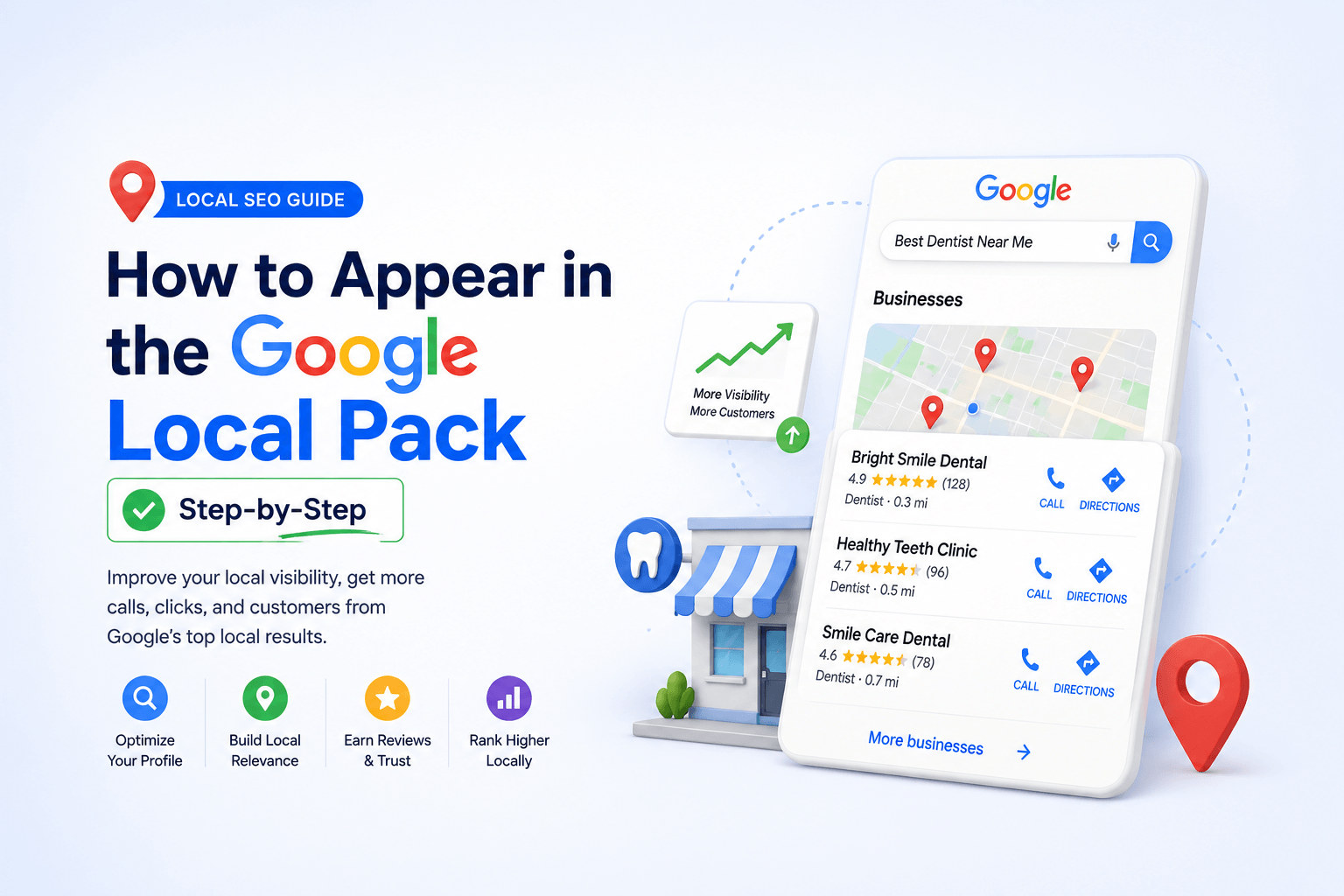
Google local pack optimization is the single highest-leverage activity a local business can pursue, because the local pack — the block of three map-pinned listings that appears above organic results for location-based searches — captures the majority of clicks before a searcher ever scrolls down the page. If your business is not appearing in this top-3 set for the searches that matter, you are losing customers to competitors who simply understood what Google evaluates and optimized accordingly.
This guide walks through the complete, step-by-step process for earning a position in the Google local pack — also referred to as the google 3 pack, google map pack, or local pack seo depending on which terminology you’ve encountered. Regardless of the name used, the underlying mechanics and the optimization framework below remain the same.
What the Google Local Pack Actually Is
When someone searches for a service tied to a location — “plumber near me,” “dentist in Austin,” “best coffee shop downtown” — Google displays a special results block above the standard organic listings. This block shows a map with three pinned business locations, each accompanied by a name, star rating, category, and key details like hours or phone number.
This feature has been referred to by several names across the SEO industry over the years: local pack, map pack, 3 pack, local 3 pack, and google local map pack. They all describe the same SERP feature. Understanding this terminology overlap matters because searchers, clients, and even some SEO tools use these terms interchangeably — and your content should speak to all of them naturally.
If you want to optimize your pages for google Local Pack?
Let’s connect with an expert.
Click a button below to talk or chat with us
Why the Local Pack Matters More Than Organic Rankings for Local Businesses
For location-based queries, the local pack sits above organic results and includes a visible map — making it the first thing a searcher’s eyes land on. Businesses appearing in this block receive a disproportionate share of clicks, calls, and direction requests compared to businesses ranking even at position 1 of standard organic results for the same query.

This is why google local pack optimization deserves dedicated strategic focus rather than being treated as a byproduct of general SEO work. The ranking mechanics are distinct, and the payoff — direct, high-intent local customers — is immediate and measurable.
The Three Ranking Pillars Behind Every Local Pack Result
Google has been explicit that local pack rankings are determined by three core factors. Understanding each pillar is essential before attempting any optimization tactics, because every action you take should map back to improving one of these three signals.
| Ranking Pillar | What Google Evaluates | Your Action |
| Relevance | How well your GBP categories and content match the search query | Choose precise primary/secondary categories; align services list |
| Distance | Proximity of your business address to the searcher’s location | Verify accurate pin location; use a real, serviceable address |
| Prominence | Overall authority — reviews, citations, backlinks, web presence | Build consistent citations, earn reviews, strengthen E-E-A-T |
Google’s own documentation on local ranking factors confirms these three pillars as the foundation of how local search results — including the local pack — are determined. Every tactic in this guide ties back to strengthening relevance, distance, or prominence.
Step 1: Build a Fully Optimized Google Business Profile
Your Google Business Profile (GBP) is the foundation of local pack visibility. An incomplete or poorly categorized profile makes it nearly impossible to compete, regardless of how strong your website or backlink profile is. Treat every field in your GBP dashboard as a ranking input, not an optional detail.
| GBP Element | Optimization Action | Priority |
| Business Name | Use exact legal/trading name — no keyword stuffing | Critical |
| Primary Category | Choose the single most accurate category for your core service | Critical |
| Secondary Categories | Add 3–9 relevant categories covering related services | High |
| Service Area / Address | Confirm pin accuracy; define service areas if applicable | Critical |
| Business Description | Write a unique 750-character description with natural keyword use | Medium |
| Photos | Upload 15+ geo-tagged photos: exterior, interior, team, work samples | High |
| Posts | Publish GBP posts weekly — offers, updates, events | Medium |
| Q&A Section | Seed 5–10 common questions with owner-answered responses | Medium |
| Products/Services List | Add full service list with descriptions and pricing if applicable | High |
| Reviews | Actively request reviews after every completed job/sale | Critical |
For a complete walkthrough of every GBP field and configuration option, see our dedicated guide on Google Business Profile optimization. That post covers the granular setup process; this guide focuses specifically on how GBP completeness translates into local pack placement.
Step 2: Strengthen Proximity and Relevance Signals
Distance is the one ranking pillar you cannot directly manipulate — Google calculates it based on the searcher’s location relative to your business address. However, you can influence how relevance is interpreted, which often determines whether you appear in the local pack for a slightly broader radius than a competitor with a more precise location.
Category Precision Over Category Volume
Many business owners assume adding more GBP categories improves visibility. In practice, an imprecise primary category dilutes relevance. If you’re a “Plumber” but selected “Contractor” as your primary category, Google may struggle to confidently match your listing to plumbing-specific searches — even if “Plumber” is listed as a secondary category.
Audit your primary category against your actual core service. Use secondary categories to capture adjacent services, not to broaden your primary positioning.
Service Area Configuration for Multi-Location Reach
If you serve customers across a broader area than your physical address suggests, configure your GBP service area settings accurately. This tells Google which neighborhoods, cities, or zip codes you intend to rank in — directly influencing whether you appear in the local pack for searches originating from those areas.
Step 3: Build Prominence Through Citations and Reviews
Prominence is the most labor-intensive pillar to build, but it also offers the most room for differentiation against competitors who have neglected it. Prominence combines two major signal categories: citation consistency and review profile strength.
Citation Consistency as a Prominence Multiplier
Every citation of your business across the web — directories, aggregators, social profiles — acts as a vote of confidence, but only if the NAP (Name, Address, Phone) data matches exactly across all sources. Inconsistent citations dilute the prominence signal rather than strengthening it.
This is covered in full depth in our guide to NAP consistency SEO, which walks through the complete audit and correction process. Treat citation cleanup as a prerequisite step before expecting local pack movement — Google cannot reward prominence signals it cannot confidently verify.
Review Velocity, Volume, and Response Rate
Reviews influence prominence in three measurable ways: total volume, average rating, and — increasingly important — review velocity (how recently and consistently new reviews arrive). A business with 50 reviews collected steadily over the past year typically outperforms a business with 200 reviews that stopped accumulating two years ago.
- Request reviews systematically: Build review requests into your service completion or checkout process — don’t rely on customers remembering to leave one unprompted.
- Respond to every review: Owner responses, especially to negative reviews, signal active business management and improve trust for prospective customers reading them.
- Avoid review gating or incentivization: These practices violate Google’s policies and risk profile suspension — a far costlier outcome than a few negative reviews.
Step 4: Reinforce Local Pack Signals With Website-Level SEO
While GBP is the primary ranking input for the local pack, your website plays a supporting role — particularly for relevance and prominence. A website that clearly reinforces your service area, services offered, and contact information strengthens the overall entity signal Google associates with your business.
Location Pages and Service-Area Content
If you serve multiple distinct locations or neighborhoods, dedicated location pages (each with unique, locally-relevant content — not duplicated boilerplate) help reinforce relevance for location-specific searches. Avoid creating thin, near-identical pages purely to target keyword variations; this can suppress rather than help rankings.
On-Page Signals That Support Local Relevance
Standard on-page SEO fundamentals still apply and compound your local pack efforts. Title tags, meta descriptions, and structured content that clearly state your service and location reinforce the same relevance signals Google is evaluating at the GBP level. Review our full on-page SEO checklist to ensure your website is not undermining the prominence you’re building through GBP and citations.
A 30-Day Google Local Pack Optimization Action Plan
Optimization efforts compound faster when sequenced correctly. Below is a practical four-week rollout plan that prioritizes the highest-impact actions first.
| Week | Focus Area | Key Tasks |
| Week 1 | GBP Foundation | Claim/verify GBP, fix categories, complete every profile field, confirm NAP accuracy |
| Week 2 | Visual & Trust Signals | Upload photos, write description, seed Q&A, request first batch of reviews |
| Week 3 | Citations & Consistency | Audit and correct NAP across Tier 1–3 directories, submit to data aggregators |
| Week 4 | Content & Momentum | Publish first GBP post, add products/services, monitor Maps ranking position |
After the initial 30 days, shift into a maintenance rhythm: monthly citation spot-checks, ongoing review requests, and quarterly GBP content refreshes (new photos, updated posts, refreshed Q&A) to keep prominence signals active rather than static.
Notice the consistently low competition index across nearly every variation — this signals a genuine ranking opportunity for a focused, well-structured piece of content like this one, rather than an oversaturated topic dominated by enterprise SEO sites.
Common Local Pack Optimization Mistakes to Avoid
- Keyword stuffing the business name: Adding location or service keywords to your GBP business name field violates Google’s guidelines and risks suspension. Use your real, registered business name only.
- Creating duplicate listings: Multiple GBP listings for the same location split your review count and citation authority instead of consolidating it. Maintain a single, verified listing per physical location.
- Ignoring the Q&A section: Unanswered or unmoderated questions can display inaccurate information publicly. Monitor and respond promptly.
- Treating GBP as “set and forget”: Profiles that go stagnant — no new photos, posts, or review responses — lose prominence momentum relative to actively managed competitor listings.
- Inconsistent NAP across the web: As covered in our NAP consistency guide, even minor formatting inconsistencies erode the trust signal Google relies on for prominence.
Frequently Asked Questions: Google Local Pack Optimization
These questions address the most common points of confusion business owners and marketers raise when working to improve local pack visibility.
What is the Google local pack?
The Google local pack (also called the Google 3 pack or map pack) is the block of three local business listings that appears at the top of Google search results for location-based queries, displayed alongside a map. It sits above the standard organic results and captures the majority of clicks for “near me” and service-plus-location searches.
How is the local pack different from regular organic rankings?
The local pack ranks businesses, not web pages, based on relevance, distance, and prominence pulled primarily from your Google Business Profile. Regular organic rankings evaluate your website’s content and backlink profile. A business can rank in the local pack without ranking on page 1 organically, and vice versa.
How long does google local pack optimization take to show results?
Most businesses see initial movement in local pack visibility within 30–60 days of consistent optimization, particularly after GBP completion and citation cleanup. Competitive markets and review-building can extend full results to 3–6 months.
Does my website need to be optimized too, or just my GBP?
Both matter. Your GBP is the primary ranking input, but Google also evaluates your website for relevance and prominence signals — especially NAP consistency, schema markup, and content that reinforces your service area and offerings.
How many reviews do I need to rank in the local pack?
There is no fixed number, but review quantity, recency, and average rating all factor into prominence. Businesses with steady review velocity (a few new reviews weekly or monthly) consistently outperform those with stagnant review profiles, regardless of total count.
Can I rank in the local pack without a physical storefront?
Yes, if you operate as a service-area business. You can hide your address on GBP and define service areas instead, though businesses with a verified physical location in a relevant area generally see stronger proximity signals.
What’s the difference between the local pack and the local 3 pack?
They refer to the same feature. “Local pack,” “3 pack,” “map pack,” and “local 3 pack” are interchangeable terms search marketers use for Google’s top-3 local business display. Google occasionally tests showing more or fewer results, but three listings remains the standard format.

No responses yet