
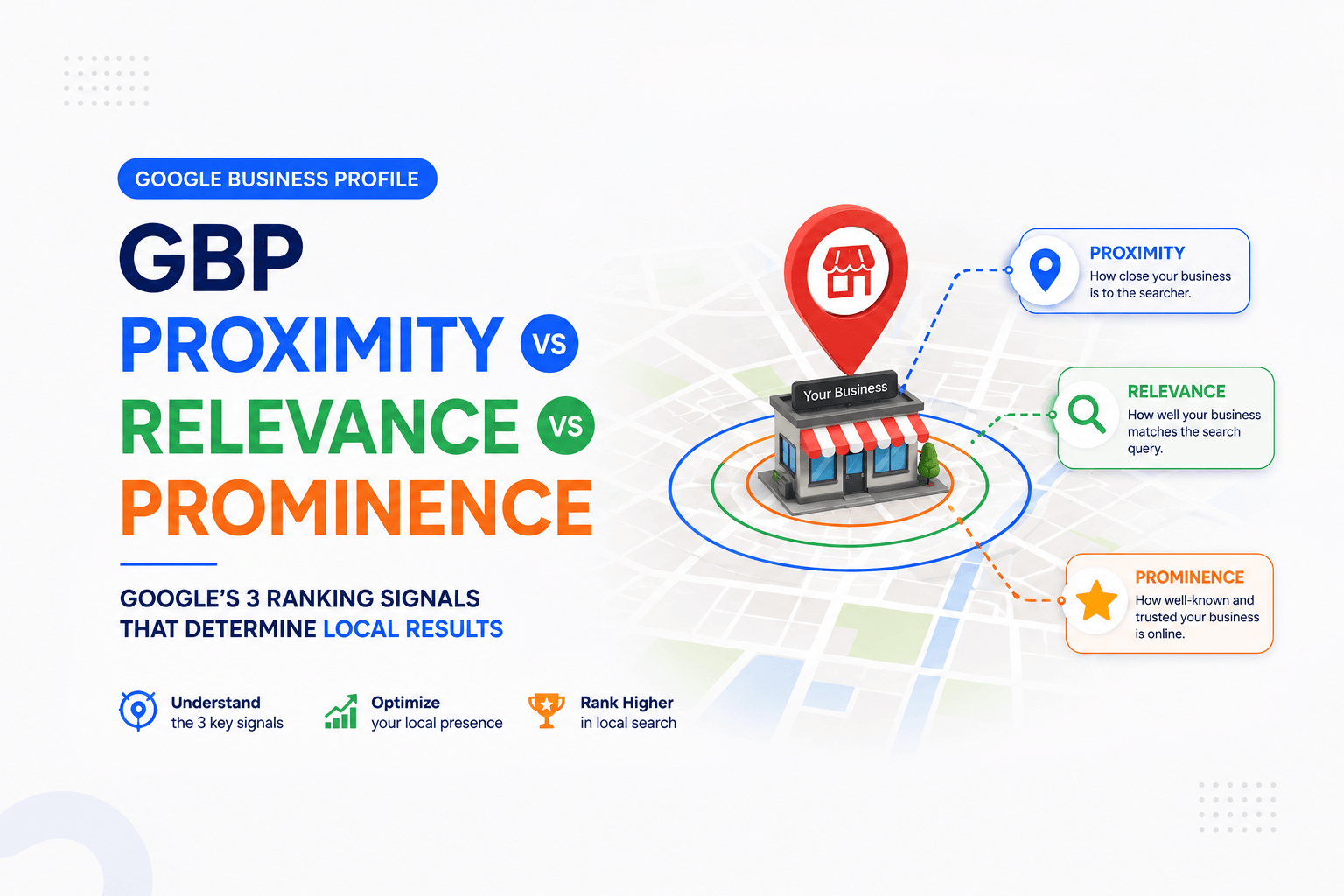
GBP ranking signals determine exactly which businesses Google surfaces first in the Local Pack, Google Maps, and the local finder — and despite the hundreds of “local SEO hacks” floating around online, every one of them ultimately feeds into three core factors Google itself names: proximity, relevance, and prominence. If you’ve optimized your Google Business Profile and you’re still not showing up for the searches that matter, the issue almost always traces back to one of these three signals being weak, ignored, or misunderstood. This guide breaks down what each signal actually measures, which ones you can realistically influence, and exactly how to strengthen all three without wasting time on tactics that don’t move the needle.
What Are GBP Ranking Signals?
GBP ranking signals are the inputs Google’s local algorithm uses to decide which businesses appear in the Local Pack and Google Maps results for a given search query. Google groups every one of these inputs into three categories: proximity (how close a business is to the searcher or the location implied in the query), relevance (how well the listing matches search intent), and prominence (how authoritative and trustworthy the business appears, both online and offline). Get all three signals working together and you have a realistic shot at the top three Local Pack positions — the spots that capture the overwhelming majority of local search clicks. This three-signal framework also sits underneath the broader approach we cover in our complete guide to building topical authority on Google, since local relevance is really just topical relevance applied to a geographic radius. If you’re newer to how Google’s algorithm works at a foundational level, our guide on search engine optimization (SEO): how websites rank on Google is a useful primer before diving into local-specific signals.
If you want to optimize your Google My Business (GMB) Profile, Book your 1-1 Consultation?
Let’s connect.
Click a button below to talk or chat with us
Google’s Official Position on GBP Ranking Signals
Google doesn’t leave this open to speculation. In its own Google Business Profile Help Center, Google states that local results are based primarily on relevance, distance, and prominence, and that a combination of these three factors determines the best match for a given search. Google even gives a useful example: a business slightly farther away can still outrank a closer competitor if it’s a stronger match for the query. Throughout the SEO industry — including in research from Moz, BrightLocal, and Whitespark — “distance” is more commonly called proximity, since it captures both physical distance and the geographic radius implied in a search, not just raw mileage. The terminology differs slightly, but the underlying signal is identical.
The 3 GBP Ranking Signals Explained
1. Proximity — The Distance-Based Signal
Proximity measures how close a business is to two reference points: the searcher’s physical location, and the geographic location implied in the search query itself (for example, someone searching “electrician in Manchester” while sitting in a different city). Proximity is the one signal you cannot directly manipulate — you can’t move your office to chase rankings — but you can influence how Google interprets it. Service-area businesses can refine their service radius instead of leaving Google’s default settings in place. Multi-location businesses can build a fully completed, individually optimized profile for each physical address rather than trying to rank one listing across several cities. And on mobile, where “near me” searches dominate, proximity tends to carry even more weight than it does on desktop.
2. Relevance — The Match-Quality Signal
Relevance measures how closely your Business Profile matches what the searcher is actually looking for. This is the signal Google gives you the most direct control over, and it’s usually the fastest one to improve. Your primary category carries more weight than your secondary categories, so accuracy matters more than breadth. Your business description, services list, attributes, Q&A section, and weekly Posts all feed Google’s understanding of what you actually do. Crucially, relevance isn’t judged by your GBP listing in isolation — Google cross-references it against your website. When your service pages use the same terminology as your profile, you reinforce the same topical signal twice instead of sending Google two slightly different stories about your business.
3. Prominence — The Authority & Trust Signal
Prominence measures how well-known, trusted, and authoritative your business appears, both on the web and in the real world. It’s built from review volume, review velocity, review recency, and average star rating, alongside citation consistency, backlink quality, brand mentions, and how strong your organic search visibility already is. Google also factors in engagement signals it can observe directly through the Profile — calls, direction requests, and website clicks all signal that real users trust what they’re seeing. Prominence compounds slowly. A business that’s been earning consistent reviews and citations for two years will almost always outrank a newer competitor with a technically “perfect” but thin profile.
How Google Weighs Proximity, Relevance, and Prominence Together
These three signals don’t operate as a simple checklist where hitting every box guarantees a top ranking — Google weighs them dynamically against each other for every individual search. A business with exceptional relevance and prominence can outrank a closer competitor, which is exactly the scenario Google describes in its own documentation. Industry research backs this up: annual studies like Moz’s Local Search Ranking Factors survey consistently find that Google Business Profile signals, review signals, and link/citation signals collectively account for the majority of ranking variance in the Local Pack — often more than raw proximity alone. The practical takeaway: never treat proximity as a ceiling on your GBP ranking signals. Strengthening relevance and prominence is almost always the higher-leverage move, because those are the levers you actually control.
Proximity vs Relevance vs Prominence: Quick Comparison
| Signal | What It Measures | Can You Control It? | Top Optimization Levers |
| Proximity | Distance between the searcher/query location and your business | Indirectly | Service area settings, pin accuracy, multi-location profiles |
| Relevance | How well your profile matches the searcher’s intent | Yes — highly | Categories, description, services, Posts, website alignment |
| Prominence | Overall authority and trust, online and offline | Yes — over time | Reviews, citations, backlinks, engagement signals |
How to Optimize Each GBP Ranking Signal
Once you understand what each signal measures, optimization becomes a matter of working through three short, repeatable checklists rather than guessing. Here’s exactly where to focus.
Optimizing Proximity
- Set and refine your service area radius instead of leaving Google’s default in place
- Keep your map pin pixel-accurate — not just your street address, the actual marker position
- Build a separate, fully completed profile for every physical location instead of one listing trying to rank in multiple cities
- Create location-specific landing pages on your website with an embedded Google Map for each service area
- Never stuff your business name with city or neighborhood keywords to “fake” proximity — this violates Google’s guidelines and risks suspension
Optimizing Relevance
- Choose the single most accurate primary category before layering on secondary categories
- Write your business description around the exact services you want to rank for, not generic marketing copy
- List every product and service individually with a short, keyword-aligned description
- Seed your own Q&A section with the questions customers genuinely ask before booking
- Publish a GBP Post weekly using the same terminology your website targets
- Mirror your GBP categories and services on your website’s service pages — see our how to rank on Google Maps guide for the full setup sequence
Optimizing Prominence
- Build a consistent review-generation system instead of waiting for reviews to arrive organically
- Respond to every review, positive or negative, within 48 hours
- Audit and correct your citations across every major directory — our local SEO citations guide walks through the exact build process
- Fix inconsistent NAP data immediately, since mismatched details actively undermine this signal
- Earn backlinks through local press, sponsorships, and relevant industry directories
- Add LocalBusiness schema markup to your website to reinforce prominence signals beyond the Profile itself
Common Mistakes That Hurt GBP Ranking Signals
- Selecting a broad or incorrect primary category to “cast a wider net” — this dilutes relevance instead of expanding it
- Running duplicate listings for the same location, which splits prominence signals across two competing profiles
- Letting NAP details drift out of sync across directories, which quietly erodes Google’s trust in your listing
- Ignoring negative reviews instead of responding, which stalls prominence growth at exactly the wrong moment
- Treating your profile as “set and forget” instead of posting, updating, and monitoring it monthly
- Buying fake reviews or using review-gating tactics, both of which violate Google’s policies and risk suspension — undermining every signal at once
Avoid these and you remove the most common reasons strong businesses fail to appear in the Google Local Pack despite an otherwise solid profile. And GBP ranking signals don’t operate in isolation from the rest of your local SEO foundation — if you haven’t already nailed the basics, our local SEO for small businesses guide covers the foundational setup these three signals build on top of.
GBP Ranking Signals Checklist
- Confirm your service area radius reflects where you actually do business
- Verify your map pin is placed at the exact correct location
- Set one accurate primary category and relevant secondary categories
- Rewrite your business description around your actual target keywords
- List every product and service individually with a short description
- Publish a GBP Post at least once a week
- Launch a standing review-generation workflow and respond to every review
- Audit and fix NAP consistency across all major citation sources
- Add LocalBusiness schema markup to your website
- Mirror your GBP categories and services on the matching website service pages
Frequently Asked Questions About GBP Ranking Signals
What are GBP ranking signals?
GBP ranking signals are the three factors — proximity, relevance, and prominence — that Google’s local algorithm uses to decide which businesses appear in the Local Pack and Google Maps for a given search.
Which GBP ranking signal matters most?
There’s no fixed hierarchy. Google weighs all three dynamically for each search, but relevance and prominence are generally the higher-leverage signals since proximity can’t be directly manipulated.
Can I control proximity in my Google Business Profile?
Not directly. You can’t move your business location to chase rankings, but you can refine service-area settings, ensure pin accuracy, and build location-specific profiles to influence how Google interprets proximity.
How do reviews affect GBP ranking signals?
Reviews are one of the strongest contributors to prominence. Review volume, recency, velocity, and average rating all signal trust and authority to Google’s local algorithm.
Does NAP consistency affect GBP ranking signals?
Yes. Inconsistent name, address, or phone number details across directories weaken prominence by undermining Google’s confidence in your business data.
How long does it take to improve GBP ranking signals?
Relevance changes — categories, description, services — can show movement within days to weeks. Prominence improvements, like reviews and citations, typically take two to six months to meaningfully shift rankings.
Do GBP ranking signals differ from organic website ranking factors?
They overlap but aren’t identical. Organic rankings lean more heavily on content and backlinks, while GBP ranking signals add proximity and profile-specific prominence factors like reviews and engagement that don’t apply to standard web pages.

No responses yet