
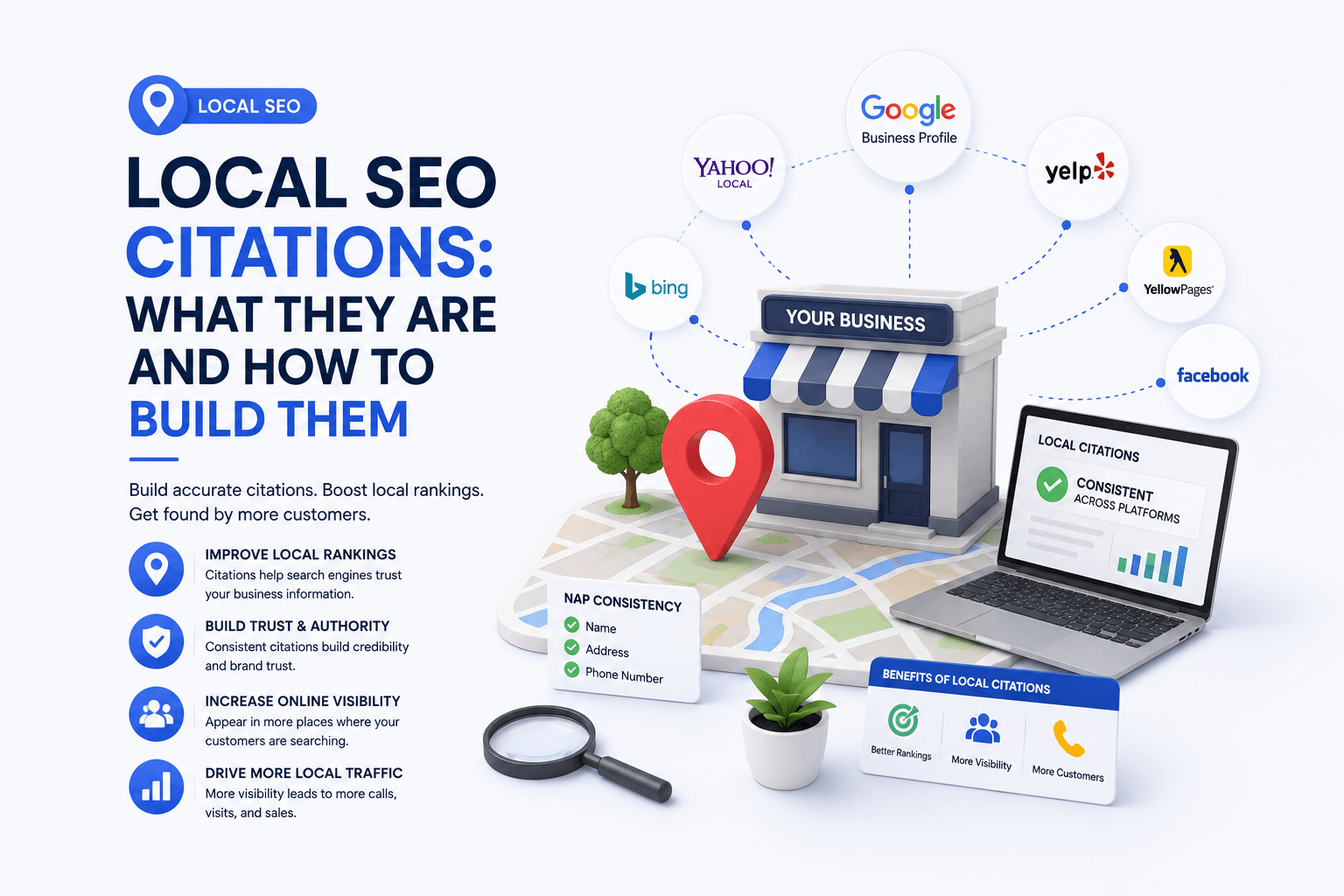
Local SEO citations are one of the most misunderstood — and most impactful — factors in local search rankings. If your business depends on customers finding you in Google Maps or the local pack, your citation profile is directly shaping whether they do. Too many businesses skip citation building altogether, while others build hundreds of inconsistent listings that quietly suppress their rankings instead of improving them. This guide breaks down exactly what local SEO citations are, how Google uses them to evaluate your business, and a precise, step-by-step process for building and maintaining a citation profile that actually moves the needle on your local visibility.
What Are Local SEO Citations?
A local SEO citation is any online mention of your business’s Name, Address, and Phone Number — collectively known as NAP. These mentions appear across business directories, review platforms, social media profiles, local websites, and even news articles. Google aggregates these signals to verify that your business is real, accurately located, and consistently represented online.
The concept is straightforward: the more high-quality, consistent citations Google finds pointing to your business with the same NAP data, the more confident it becomes in your entity — and the higher it ranks you in local search results and the Google Maps pack.
The Core NAP Components That Define a Citation
Every citation is built around these foundational data points. Consistency across all of them — on every platform — is non-negotiable for strong local SEO performance.
| NAP Component | What It Includes & Why It Matters |
| Business Name | Exact legal or trading name — must match Google Business Profile perfectly |
| Address | Street, city, state/region, postal code — no abbreviations or formatting variations |
| Phone Number | Local number preferred; consistent format across all platforms |
| Website URL | Same URL (www vs non-www, http vs https) on every citation |
| Business Category | Aligns with how Google classifies your business |
| Business Description | Optional but adds semantic context for search engines |
Want to optimise your local citations?
Let’s connect with an expert.
Click a button below to talk or chat with us
Why Local SEO Citations Matter for Google Rankings
Citations function as trust signals for Google. When your business NAP data appears consistently across authoritative directories, Google’s algorithm interprets this as evidence that your business is established, legitimate, and accurately located. This directly influences three local ranking factors: relevance, distance, and — most critically — prominence.

Google’s own How Google determines local ranking documentation explicitly states that prominence is partly based on information Google has about a business from across the web. Citations are a primary source of that information.
Independent research from Moz Local Search Ranking Factors consistently places citation signals among the top factors influencing local pack rankings. The emphasis, however, has shifted from raw citation volume to citation quality, authority, and NAP consistency. One hundred inconsistent citations will hurt you more than twenty accurate ones on high-authority platforms.
Citations vs. Backlinks: Understanding the Difference
Both citations and backlinks signal authority to Google, but they operate differently. A backlink requires a hyperlink. A citation does not — an unlinked mention of your business name, address, and phone number on a reputable local website still carries SEO weight. In local SEO, citations and backlinks work together: citations establish entity trust, while backlinks build domain authority.
To understand where citations fit within your broader local strategy, read our guide on how to rank on Google Maps — it covers the full ranking system that citations support.
Types of Local Citations: Structured vs. Unstructured
Not all citations are created equal, and not all of them come from traditional directories. Understanding the different types helps you build a more strategic and diverse citation profile.
| Citation Type | Examples | SEO Impact | Strategic Value |
| Structured Citations | Yelp, Yellow Pages, Bing Places, Apple Maps | High | Direct ranking signal, easy to control |
| Unstructured Citations | Blog mentions, news articles, local directories | Medium | Hard to build at scale; high trust value |
| Aggregator Citations | Data Axle, Localeze, Acxiom | High | Distribute your NAP to hundreds of directories |
| Industry Citations | Avvo (legal), Healthgrades (medical), Houzz (home) | Very High | Strong vertical authority signals |
| Local Citations | Chamber of Commerce, city business directories | High | Geo-relevance signal for map pack rankings |
Aggregator Citations: The Multiplier Effect
Data aggregators like Data Axle, Localeze, and Acxiom act as wholesale distributors of business information. When you submit accurate NAP data to these networks, they push it out to hundreds of downstream directories automatically. This is why tools like Moz Local and BrightLocal are valuable — they plug into aggregator networks and push your data at scale, saving hundreds of hours of manual submission.
Industry-Specific Citations: High Leverage Opportunities
For businesses in niche verticals, industry-specific directories often carry more ranking weight than general directories. A law firm listed on Avvo sends a stronger relevance signal than the same firm listed on a generic business directory. Identify the top 5–10 directories specific to your industry or profession and prioritize them above general platforms.
How to Audit Your Existing Citation Profile
Before building new local citations, audit what already exists. Incorrect or inconsistent citations actively suppress your rankings. Fixing existing data is always higher priority than adding new citations on top of a broken foundation.
| Audit Action | Purpose |
| Search your business name on Google | Identify existing mentions and their NAP accuracy |
| Search business name + city | Uncover local directory listings |
| Search phone number in quotes | Find listings that may have old/wrong data |
| Use Moz Local or BrightLocal audit tool | Automated citation discovery across major platforms |
| Check all major platforms manually | Google, Yelp, Bing, Apple Maps, Facebook |
| Document every discrepancy found | Build a correction queue before building new citations |
| Fix inconsistencies before adding new citations | Duplicate or inconsistent NAP confuses Google’s entity disambiguation |
Tools for Citation Auditing
Manual auditing works for small profiles, but purpose-built tools dramatically accelerate the process:
- Moz Local — scans your NAP data against major directories, identifies inconsistencies, and scores your citation health
- BrightLocal Citation Tracker — monitors citations across 1,400+ directories and flags errors
- Whitespark Local Citation Finder — identifies citation opportunities by analyzing your competitors’ citation profiles
- Google Search — simple manual check: search “Business Name” + “City” to surface existing mentions
How to Build Local SEO Citations: Step-by-Step
Building local citation citations is a systematic process. Rushing it — or doing it inconsistently — creates the exact problems you are trying to avoid. Follow this sequence precisely.
Step 1: Standardize Your NAP Data Before You Start
Before submitting to any directory, lock down your canonical NAP format. Decide on the exact spelling of your business name, the exact address format, and the exact phone number format. Document this in a reference file and use it identically everywhere.
Common mistake to avoid: mixing “St.” and “Street” in your address, or listing “The Coffee Lab” on some platforms and “Coffee Lab” on others. Google treats these as separate entities, which splits your citation authority.
Step 2: Claim and Optimize Core Platform Listings
Start with the platforms Google prioritizes when evaluating local businesses. These are your essential foundation citations — they must be perfect before you build anywhere else.
- Google Business Profile — verify ownership and fully optimize every field
- Bing Places for Business — often overlooked but directly feeds Microsoft search
- Apple Maps Connect — critical for iPhone users and Siri local searches
- Facebook Business Page — Google reads Facebook business data as a citation source
- Yelp — one of the highest-authority general directories globally
Step 3: Submit to High-Authority General Directories
After the core platforms, move to major general directories. Prioritize authority over volume — a listing on Yellow Pages, Foursquare, or Citysearch carries more weight than fifty low-quality local directories with thin traffic.
| Directory | Platform | Best For | Priority |
| Google Business Profile | google.com/business | All businesses | Essential |
| Bing Places for Business | bingplaces.com | All businesses | Essential |
| Apple Maps Connect | mapsconnect.apple.com | All businesses | Essential |
| Yelp | yelp.com | All businesses | High |
| Facebook Business | facebook.com/business | All businesses | High |
| Yellow Pages | yellowpages.com | All businesses | High |
| Foursquare | foursquare.com | All businesses | Medium |
| Moz Local | moz.com/local | All businesses | High (aggregator) |
| Avvo | avvo.com | Legal professionals | Very High (niche) |
| Healthgrades | healthgrades.com | Healthcare | Very High (niche) |
| Houzz | houzz.com | Home services | Very High (niche) |
| TripAdvisor | tripadvisor.com | Hospitality/Travel | High (niche) |
Step 4: Build Industry-Specific and Local Citations
Once your general directory foundation is solid, layer in niche and local citations:
- Industry directories: Avvo (legal), Healthgrades (healthcare), Houzz (home services), TripAdvisor (hospitality)
- Local chamber of commerce: membership often includes a directory listing that Google specifically recognizes
- City and regional directories: local government business registries, neighborhood association sites, local newspaper business sections
- Partner and association websites: trade association member directories, franchise or partner directories
Step 5: Use Aggregators for Scale
Submit your NAP data to the major data aggregators. Tools like Moz Local connect directly to Data Axle, Neustar Localeze, and Foursquare’s network — one submission pushes your data to hundreds of downstream platforms. This is how you efficiently build local citation building at scale without manually submitting to every minor directory individually.
Step 6: Monitor and Maintain
Citations decay over time. Platforms merge, close, or update their data independently. Set a quarterly reminder to audit your top 20 citations manually, and use Moz Local or BrightLocal for ongoing monitoring of your full citation profile.
NAP Consistency: The Foundation That Makes or Breaks Citations
Every piece of local citation building advice comes back to this: NAP consistency is the single most important technical factor in citation SEO. Google uses entity disambiguation — the process of determining whether two mentions on the web refer to the same business — to consolidate citation signals. Inconsistent NAP data creates ambiguity, which reduces how much credit Google assigns to your full citation profile.
| NAP Consistency Checklist Item | Done? |
| Business name identical on every platform | |
| Same address format (no abbreviation variation) | |
| Consistent phone number format | |
| Same website URL (including www/https) | |
| Same business category selection | |
| No duplicate listings on same platform | |
| Closed/inactive listings claimed and removed | |
| Primary keyword in business description |
For a deeper understanding of how NAP consistency interacts with your full local SEO strategy, see our article on local SEO for small businesses, which covers the full ranking framework beyond citations alone.
Free Local Citations Worth Building Right Now
Not every valuable citation requires a paid subscription. Several free local citations platforms carry strong domain authority and are actively read by Google’s crawlers. The following are non-negotiable starting points for any local business:
- Google Business Profile — free, essential, and the single highest-impact citation for local rankings
- Bing Places — free, directly feeds Bing Maps and influences Cortana / Microsoft local results
- Apple Maps Connect — free and increasingly important as iPhone usage for local search grows
- Facebook Business Page — free, high-authority, and treated by Google as a structured citation source
- Yelp — free basic listing available; high domain authority and strong Google trust signal
- Yellow Pages — free listing available; one of the oldest and most-indexed directories online
- LinkedIn Company Page — free and valuable for professional service businesses and B2B companies
- Better Business Bureau — free basic listing; high trust signal particularly for service businesses
While free local citations are a solid starting point, investing in an aggregator tool (Moz Local starts at approximately $129/year) pays off quickly in time saved and citation coverage that free manual submissions cannot match at scale.
Common Citation Mistakes That Suppress Local Rankings
These are the errors that quietly kill local SEO performance — and are often the root cause when a business ranks on page two despite having strong reviews and an optimized Google Business Profile.
- Inconsistent business name formatting — ‘The Coffee Lab’ vs ‘Coffee Lab’ vs ‘THE COFFEE LAB’ are three different entities to Google
- Multiple listings on the same platform — duplicate citations split your citation authority and trigger suppression filters
- Using a virtual office address — Google penalizes businesses that cannot be physically verified at their listed address
- Old phone numbers still live on directories — especially damaging after a business moves or changes its number
- Building volume without fixing inconsistencies first — amplifies the existing problem rather than solving it
- Ignoring industry-specific citations — missing niche directories means missing vertical relevance signals Google values highly
- Not claiming existing listings — unclaimed listings can be edited by anyone, including competitors or malicious actors
Local SEO Citations and the Broader Topical Authority Strategy
Citation building is one layer of a multi-signal local SEO strategy. To build genuine local SEO visibility that compounds over time, citations need to work alongside optimized on-page content, a strong Google Business Profile, earned reviews, and a coherent internal linking structure that reinforces your topical authority.
If you want to understand how all of these elements connect at the strategic level, our topical authority and semantic SEO guide explains the full framework. For the specific mechanics of search engine rankings beyond local, see our SEO fundamentals guide.
Frequently Asked Questions: Local SEO Citations
| Question | Answer |
| What are local SEO citations? | Local SEO citations are any online mentions of your business’s name, address, and phone number (NAP). They appear on directories, review sites, social platforms, and websites. Google uses them to verify your business’s existence and measure its local authority. |
| Do local citations still matter for SEO in 2025? | Yes. Citations remain a significant local ranking factor confirmed by Google’s own documentation and Moz Local Search Ranking Factors research. Their importance has shifted from volume toward consistency and quality — accurate, duplicate-free citations on authoritative platforms carry far more weight than hundreds of low-quality mentions. |
| What is NAP consistency and why does it matter? | NAP stands for Name, Address, and Phone Number. Consistency means these three data points are identical across every online platform. Inconsistencies — like abbreviated street names, old phone numbers, or punctuation variations — create conflicting signals that weaken your local rankings. |
| How many citations do I need to rank locally? | There is no universal number. Your citation count should match or exceed the average for your category and city. Tools like Moz Local or BrightLocal let you benchmark your citation profile against local competitors to identify the gap. |
| What is the difference between structured and unstructured citations? | Structured citations appear in formatted business directory fields (name, address, phone). Unstructured citations are organic mentions of your business in blog posts, articles, or news content. Both matter, but structured citations are easier to control and audit. |
| Are free local citations worth building? | Yes, especially on high-authority platforms. Google Business Profile, Bing Places, Apple Maps, Yelp, and Facebook Business are all free and carry significant ranking weight. Paid citation services like Moz Local or BrightLocal are worth the investment for their aggregator distribution network. |
| How do I fix incorrect citations? | Claim each listing through the platform’s verification process. Update the NAP data manually and, where needed, submit a correction request. For large-scale correction, Moz Local and BrightLocal offer automated suppression and correction tools that push accurate data across their partner networks. |

No responses yet