
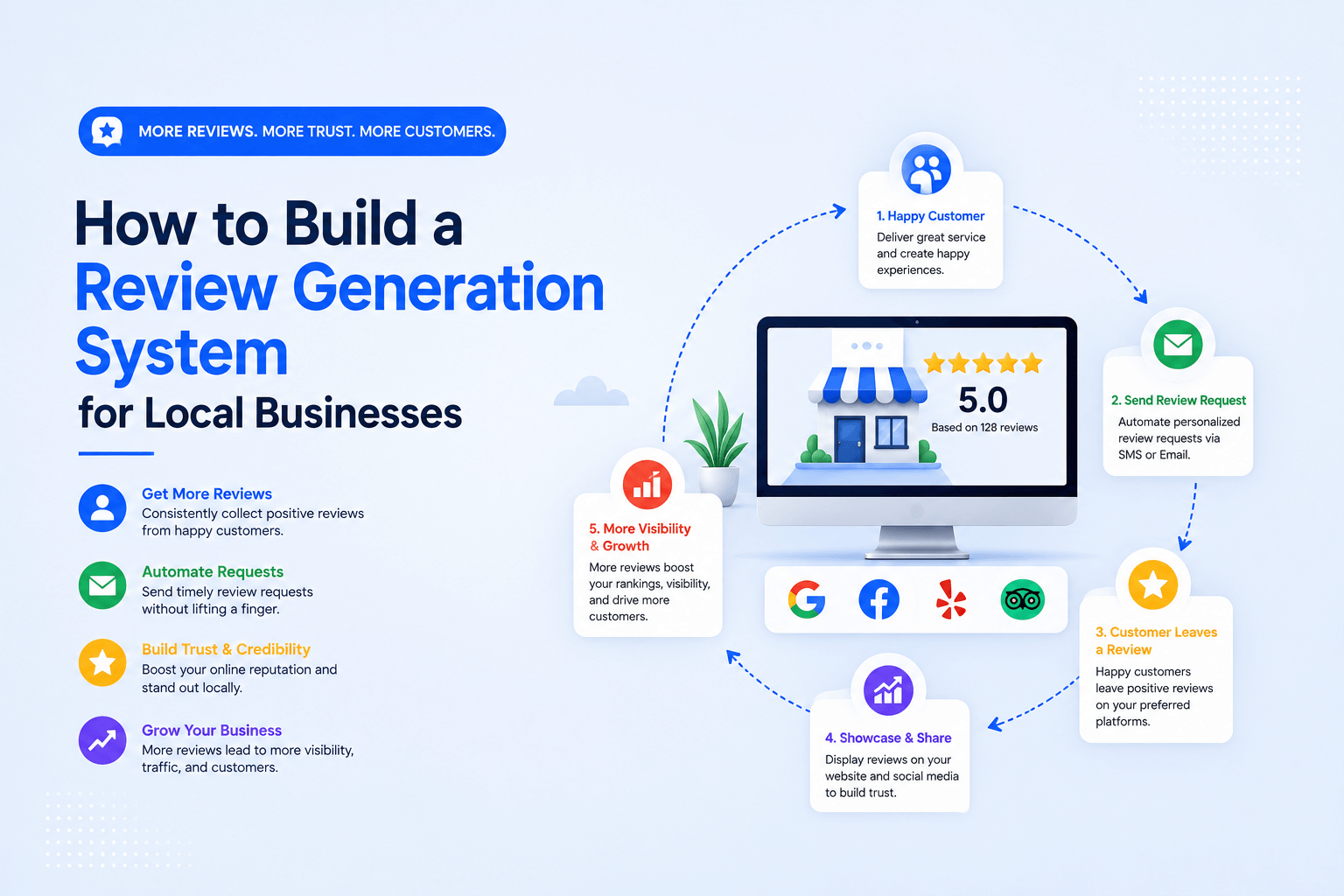
A review generation system for local business is a repeatable process — not a one-off request — that turns every satisfied customer into a public 5-star review, on a predictable cadence, without ever violating Google’s review policies. Most local businesses treat reviews as an afterthought: they ask occasionally, forget to follow up, and watch their star count stagnate while a competitor down the street pulls ahead in the local pack. A proper system fixes that by engineering the ask, the timing, and the follow-through into the customer journey itself.
Have you problem with reviews optimization and management
Let’s connect make a smooth system for review generation.
Click a button below to talk or chat with us
This guide closes out Cluster 3 of this site’s reputation management series. If you haven’t already established why reviews matter for rankings in the first place, start with how Google reviews affect local rankings, then come back here to build the acquisition engine that keeps those signals compounding month after month.
Why Local Businesses Need a Review Generation System (Not Just a Review Ask)
Review count and review recency are two of the strongest inputs into Google’s local ranking algorithm, sitting alongside proximity, relevance, and prominence scoring. A business with 4 reviews from 2023 looks dormant to both Google and the searcher. A business generating 8–12 fresh, keyword-rich reviews per month signals an active, trusted, high-demand entity — and that review velocity directly feeds prominence and Share of Local Voice within the map pack.
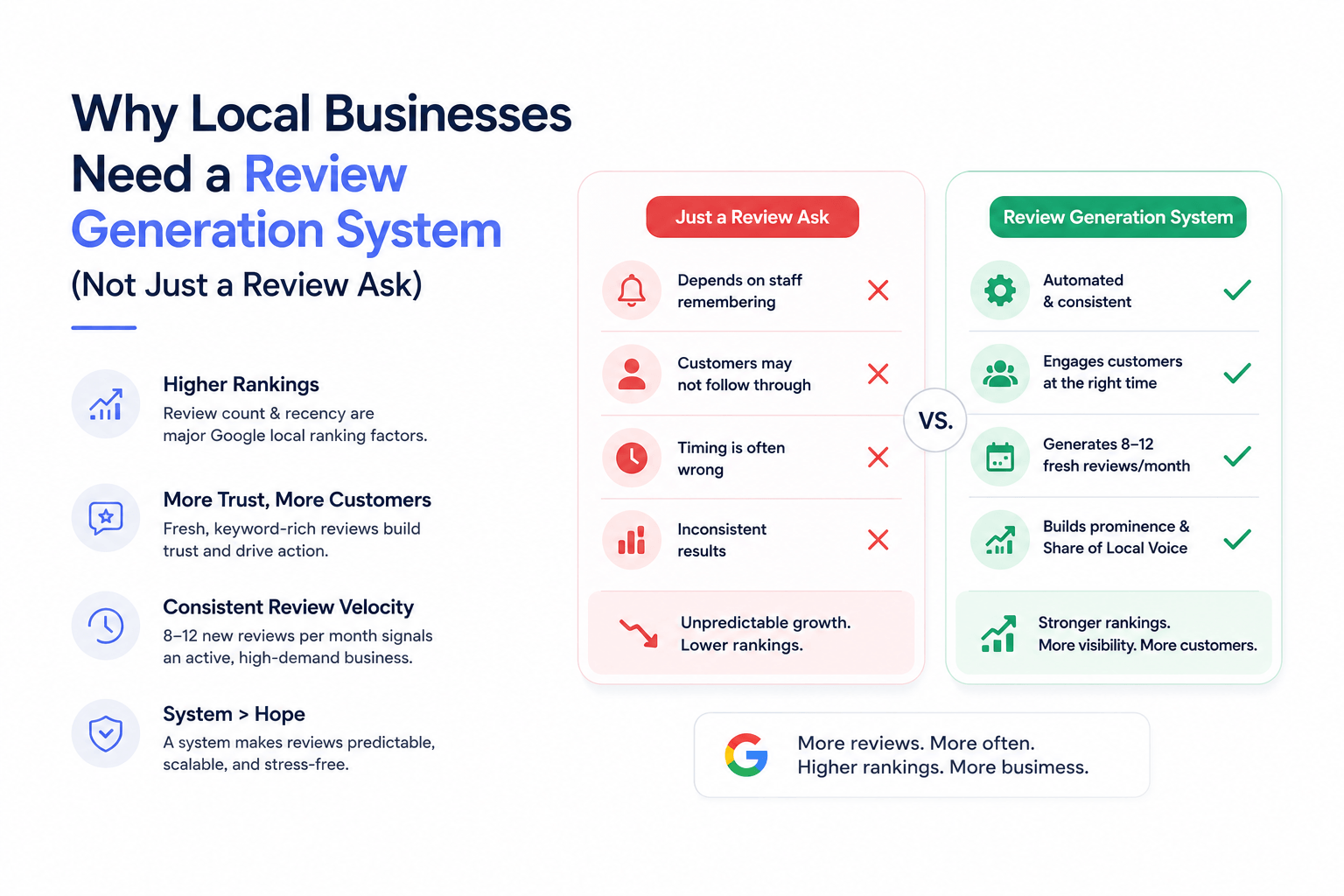
The problem is that asking for reviews doesn’t scale. It depends on staff remembering, customers following through, and the timing being right. A system removes that dependency. It’s the difference between hoping for reviews and manufacturing them ethically, on a schedule your team doesn’t have to think about.
| Industry Data Point: According to BrightLocal’s Local Consumer Review Survey, the vast majority of consumers now read online reviews before choosing a local business, and recency of reviews is one of the top factors influencing trust — reinforcing why review velocity, not just total volume, is the metric that matters. |
The Core Components of a Review Generation System
Every functioning system, regardless of business size, is built from five interlocking components. Skip any one of them and the system leaks — you’ll generate a burst of reviews and then watch volume fall back to zero within a quarter.
1. A Defined “Ask Moment” in the Customer Journey
The single biggest driver of review conversion rate is timing. The request has to land at the moment satisfaction peaks — right after a successful service completion, a resolved support ticket, or a positive checkout experience — not days later in a generic monthly newsletter. Map your customer journey and identify the one or two moments where sentiment is provably highest, and build your capture funnel around only those moments.
2. First-Party Review Capture Funnel
A capture funnel is the actual path a customer walks to leave a review: a text message with a direct link, a QR code on a receipt or table tent, or an on-site kiosk immediately after service. The best-performing funnels use pre-filtering — a private micro-survey that routes happy customers to the public Google review link and routes dissatisfied customers to a private feedback form instead. This protects your public rating without ever manipulating or gating who’s allowed to leave a review (more on that compliance line below).
3. Automated Request Cadence via CRM Triggers
Manual requests die out within weeks. Automation doesn’t. Connect your review request to a CRM or booking-system trigger — job marked complete, invoice paid, appointment closed — so the request fires automatically, every time, without a staff member remembering to send it. Most local businesses that successfully increase review volume are the ones that first fix their capture and cadence, which is covered in more depth in how to get more Google reviews.
4. Response and Monitoring Workflow
Generation without response is half a system. Every new review — positive or negative — needs a same-week reply. Responding reinforces EEAT signalling for Google and shows future customers the business is actively managed. For the response scripts and tone frameworks themselves, see how to respond to Google reviews, and for damage control on 1- and 2-star reviews specifically, see how to handle negative Google reviews.
5. Sentiment & Velocity Tracking
The final component is measurement. Track review velocity (reviews per month), star rating distribution, average response time, and sentiment trends over time. Without tracking, you can’t tell whether a change to your capture funnel actually moved the needle or whether volume dipped because of a seasonal slowdown.
Review Channel Comparison: Where to Invest First
Not every channel deserves equal investment. The table below reflects typical performance patterns across local business categories — use it to decide which one or two channels to build first rather than trying to launch all five at once.
| Capture Channel | Typical Response Rate | Best Use Case | Key Risk |
| SMS text link | 20–35% | Service businesses, on-site jobs | Requires customer opt-in / phone capture |
| Email follow-up | 8–15% | E-commerce, appointment-based | Low open rates without a strong subject line |
| QR code (receipt/table) | 10–20% | Retail, hospitality, walk-in | Depends on staff mentioning it verbally |
| In-person kiosk/tablet | 25–40% | High foot-traffic locations | Hardware cost and upkeep |
| Post-service app prompt | 15–25% | Apps, delivery, on-demand services | Needs existing app adoption |
Step-by-Step: Building Your Review Generation System for local business
This is the build sequence in the order it should actually happen. Trying to automate before you’ve defined the ask moment, or tracking metrics before you have a capture funnel, is the most common reason these systems stall out.
- Audit your current review profile — total count, average rating, review velocity over the last 6 months, and response rate on existing reviews.
- Identify your single highest-sentiment moment in the customer journey and design the ask around it exclusively.
- Build (or buy) a capture funnel with private pre-filtering to route feedback appropriately, without ever blocking or discouraging any customer from leaving a public review.
- Connect the request trigger to your CRM, POS, or booking system so it fires automatically post-transaction.
- Set a response SLA (48–72 hours) and assign ownership — this cannot be an “if we get to it” task.
- Track velocity, star distribution, and sentiment monthly, and adjust the ask-moment timing based on what the data shows.
Scaling a Review Generation System Across Multiple Locations
Multi-location brands face an additional layer of complexity: each Google Business Profile location competes — and gets measured — independently. A review generation system that works for a single storefront needs location-level tagging so requests route to the correct GBP listing and NAP consistency stays intact across every location. This is closely tied to the broader multi-location ranking strategy covered in Google Maps multi-location SEO, where geo-grid rank tracking becomes the standard way to measure whether review velocity is actually improving prominence scoring location by location.
Compliance: Staying on the Right Side of Review Gating Rules
Review gating — filtering customers so only happy ones are invited to leave a public review while unhappy ones are redirected away — is explicitly prohibited under Google’s review policies, and separately banned under the FTC’s 2024 rule on fake and manipulated reviews. The private pre-filter step described earlier is only compliant when every customer, regardless of sentiment, still has an unobstructed path to the public review platform. Pre-filtering for internal triage is fine; blocking access based on sentiment is not.
| Compliance Warning: Never disable, hide, or remove the public review link for customers who indicate dissatisfaction in a pre-survey. Route their feedback privately, but always leave the public review option available and unchanged for every customer. |
Measuring Success: The KPIs That Actually Matter
- Review velocity — new reviews generated per month, tracked against a 3-month rolling average.
- Star rating distribution — the ratio of 5-star to 1–2-star reviews, not just the average.
- Response rate and response time — percentage of reviews answered within your SLA window.
- Keyword co-occurrence in reviews — how often customers naturally mention your services or location, which strengthens entity coherence and semantic context for the listing.
- Share of Local Voice — your review volume and rating relative to the top 3 competitors in the same map pack radius.
Common Mistakes That Stall Review Generation Systems
- Asking too late — after the customer has left, moved on, or forgotten the specific experience.
- Relying entirely on staff memory instead of an automated CRM trigger.
- Ignoring negative reviews instead of using the response framework in how to handle negative Google reviews.
- Treating review generation as a one-time campaign instead of an always-on system tied to local SEO for small businesses as a whole.
- No tracking — so there’s no way to know whether velocity is actually improving month over month.
Where This Fits Into Your Broader Local SEO Strategy
A review generation system doesn’t operate in isolation — it’s one input into the same prominence and relevance signals covered across search engine optimization (SEO) fundamentals. Pair it with consistent NAP data, a strong Google Business Profile, and the response workflows already covered in this cluster, and review velocity becomes one of the most controllable ranking levers a local business has.
Frequently Asked Questions
Q1. What is a review generation system for local business?
It’s an automated, repeatable process that requests, captures, and responds to customer reviews at scale — typically triggered by a CRM or booking system event — rather than relying on staff to manually ask each customer.
Q2. How many Google reviews should a local business get per month?
There’s no universal number, but businesses competing in a moderately dense local pack typically benefit from generating 8–15 new reviews per month to sustain review velocity relative to competitors.
Q3. Is asking customers for reviews against Google’s policy?
No. Asking for reviews is explicitly allowed. What’s prohibited is review gating — selectively inviting only satisfied customers while blocking dissatisfied ones from the public review path.
Q4. What’s the best channel for requesting reviews?
SMS text links and in-person kiosks tend to convert highest, but the right channel depends on how your business already interacts with customers post-transaction — email works better for e-commerce, SMS works better for service businesses.
Q5. How soon after a purchase should a review request go out?
As close to the peak-satisfaction moment as possible — usually within a few hours to 48 hours of service completion, not days or weeks later.
Q6. Do review generation systems work for multi-location businesses?
Yes, but each location needs its own tagged request flow so reviews route to the correct Google Business Profile, keeping NAP consistency intact across every listing.
Q7. Can review generation software improve local SEO rankings?
Indirectly, yes. The software itself doesn’t rank anything, but the review velocity and fresh, keyword-rich review content it produces feed directly into the prominence signals Google uses for local pack rankings.

No responses yet