
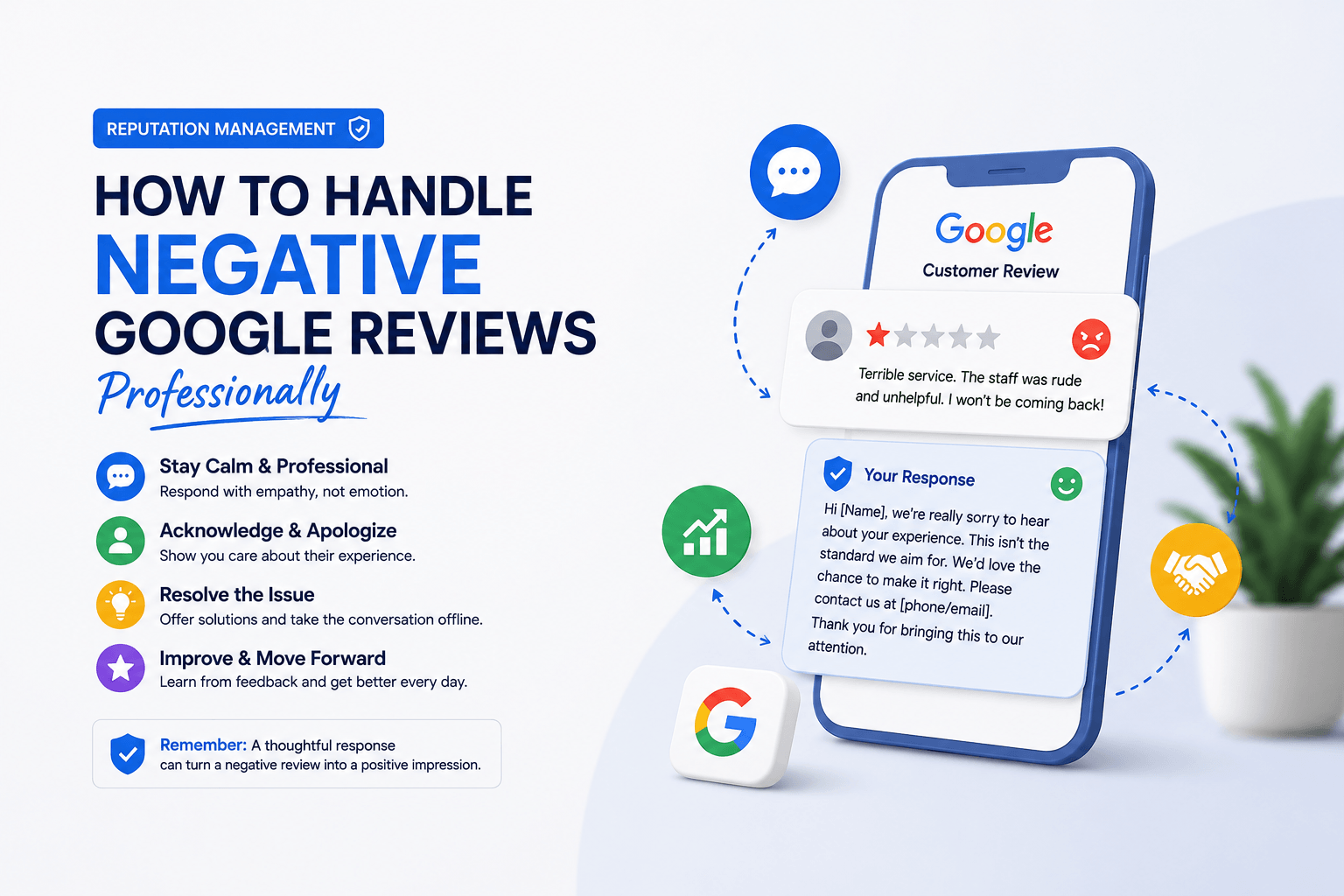
Negative Google reviews response planning is the single biggest factor separating businesses that recover their reputation from those that watch it erode in public. A one-star review sitting unanswered for days does more damage than the review itself — it signals to every future customer that nobody is listening. The good news is that a structured, professional response system can neutralize the damage, demonstrate accountability, and in many cases turn a critic into a returning customer.
This guide breaks down the exact framework for responding to negative reviews on Google Business Profile (GBP): the psychology behind it, word-for-word response templates, escalation protocols for fake or abusive reviews, and the EEAT signalling that Google’s algorithm increasingly rewards.
Have you problem with reviews optimization and management
Let’s connect to an expert.
Click a button below to talk or chat with us
Why Your Negative Google Reviews Response Strategy Affects Rankings, Not Just Reputation
Most business owners treat review responses as a customer service formality. In reality, Google’s local algorithm treats review engagement as a prominence signal. Businesses that respond consistently — especially to negative feedback — show stronger engagement velocity, which factors into local pack visibility alongside relevance and distance.
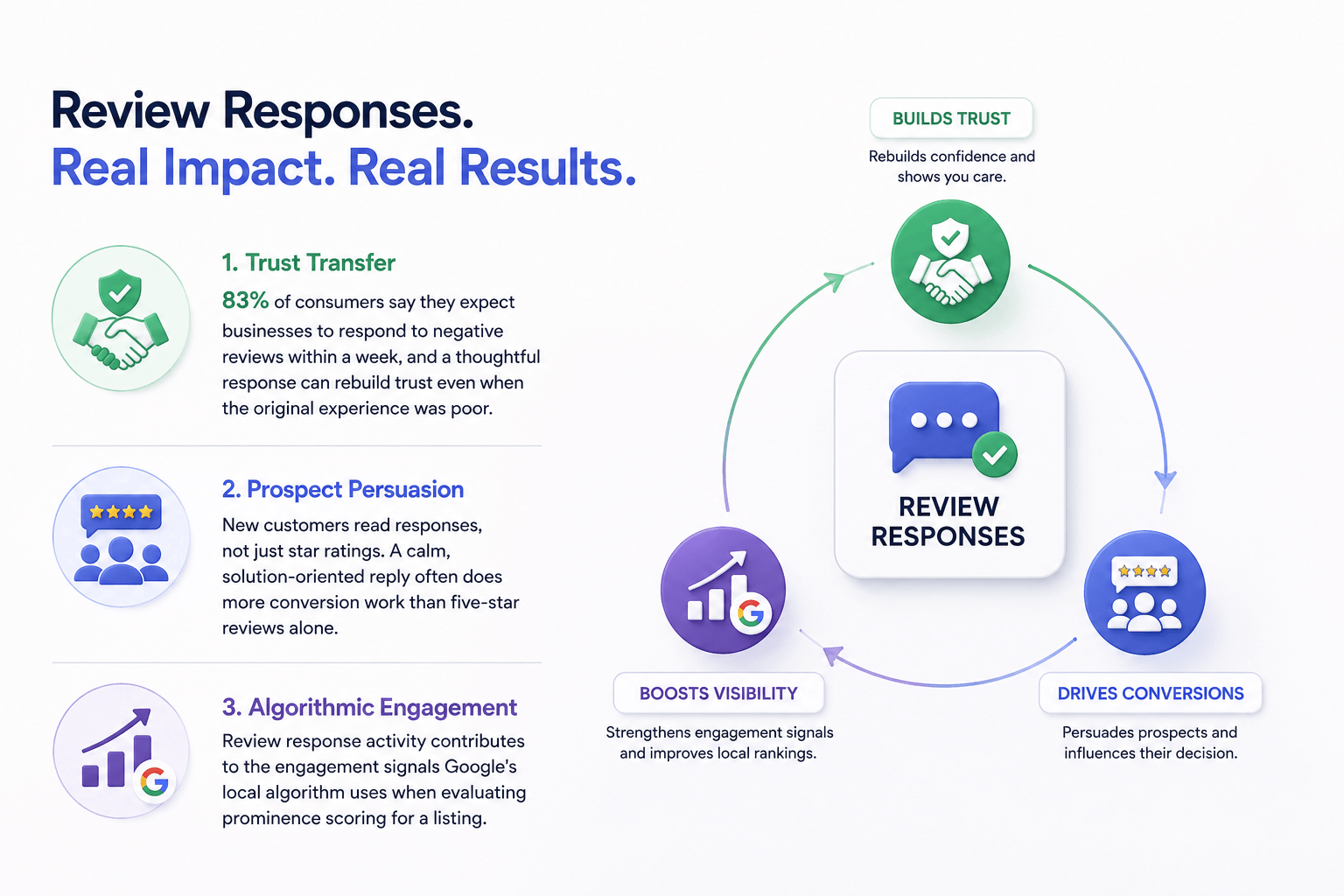
- Trust transfer: 83% of consumers say they expect businesses to respond to negative reviews within a week, and a thoughtful response can rebuild trust even when the original experience was poor.
- Prospect persuasion: New customers read responses, not just star ratings. A calm, solution-oriented reply often does more conversion work than five-star reviews alone.
- Algorithmic engagement: Review response activity contributes to the engagement signals Google’s local algorithm uses when evaluating prominence scoring for a listing.
If you haven’t yet built the foundation for review generation, start with How to Get More Google Reviews, and pair it with our broader breakdown on How to Respond to Google Reviews for tone and format basics before applying the negative-review playbook below.
The Psychology Behind an Effective Negative Review Response
Before drafting a single word, understand who you’re actually writing for. The reviewer is your primary audience emotionally, but the prospective customer reading the thread later is your primary audience strategically. Every response is a public-facing reputation asset.
The Three Audiences of Every Response
- The original reviewer, who wants to feel heard and validated.
- Future prospects, who are evaluating how your business handles conflict.
- Google’s algorithm, which reads engagement, recency, and resolution language as authority signals.
The 6-Step Negative Google Reviews Response Framework
This framework applies whether the review is a legitimate complaint, a misunderstanding, or borderline fake. Use it as a repeatable template across your team.
Step 1: Respond Within 24–48 Hours
Speed signals operational discipline. Delayed responses compound frustration and reduce the likelihood the reviewer will revise their rating. Set up Google Business Profile notifications or a review monitoring tool so no negative review sits unanswered.
Step 2: Acknowledge Before You Explain
Lead with empathy, not justification. Reviewers who feel dismissed rarely engage further, and prospects reading the exchange can tell the difference between genuine acknowledgment and scripted defensiveness.
Step 3: Take Specifics Offline
Public responses should stay general. Invite the reviewer to a direct channel — phone, email, or a dedicated reputation inbox — for account-specific or sensitive details. This protects customer privacy and prevents a public back-and-forth that damages perception further.
Step 4: Offer a Concrete Resolution Path
Vague apologies read as hollow. Specify what you’re doing: a refund review, a manager follow-up call, a process audit. Concrete action items demonstrate EEAT — particularly the ‘experience’ and ‘trustworthiness’ components Google’s quality raters evaluate.
Step 5: Keep It Brief and On-Brand
Two to four sentences is typically sufficient. Overlong responses can read as defensive. Match your brand voice consistently across responses to reinforce entity coherence in how your business is perceived online and by AI-driven search summaries.
Step 6: Monitor for Revision or Removal
After resolving the issue offline, it’s appropriate to politely ask whether the reviewer would consider updating their rating — never demand it. Track resolution outcomes to identify recurring operational issues driving review velocity in the negative direction.
Negative Review Response Benchmarks by Industry
Response expectations vary by sector. The table below offers general benchmarks to calibrate your internal SLA for review response.
| Industry | Expected Response Time | Typical Resolution Window |
| Hospitality & Food Service | Within 24 hours | 1–3 days |
| Healthcare & Professional Services | Within 48 hours | 3–5 days |
| Retail & E-Commerce | Within 24–48 hours | 2–4 days |
| Home Services & Trades | Within 48–72 hours | 3–7 days |
| B2B & SaaS | Within 72 hours | 5–10 days |
| Quick Tip: Never Use Generic Copy-Paste Responses Google’s quality systems and human readers can both detect templated, repeated language across multiple reviews. Vary your phrasing while keeping your core resolution process consistent — this protects EEAT signalling and reads as authentic rather than automated. | ||
How to Handle Fake or Policy-Violating Negative Reviews
Not every negative review is legitimate. Competitors, disgruntled former employees, or reviews unrelated to an actual transaction can be flagged for removal through Google’s review policies.
- Flag the review directly through your Google Business Profile dashboard, citing the specific policy violation.
- Document evidence — transaction records, timestamps, or correspondence — that supports the claim the review is illegitimate.
- Avoid public accusations in your response; let the flagging process run while keeping your public reply neutral and professional.
- Reference Google’s official guidance on prohibited and restricted content when building your internal escalation documentation.
Copy-Paste Response Templates
Use these as starting frameworks, then personalize each one with specific details from the actual interaction.
| Template 1: Service Complaint “Thank you for sharing this feedback — we’re sorry your experience didn’t reflect the standard we aim for. We’d like to make this right; please reach out to [contact method] so our team can look into what happened and follow up directly.” |
| Template 2: Pricing or Billing Dispute “We appreciate you flagging this. Billing concerns are something we take seriously, and we’d like to review your account details directly. Please contact us at [email/phone] so we can resolve this as quickly as possible.” |
| Template 3: Misunderstanding or Mismatched Expectations “Thanks for the honest feedback. It sounds like there was a gap between what was expected and what was delivered — we’d value the chance to clarify and improve. Feel free to reach out at [contact method] so we can talk it through.” |
| Template 4: Suspected Fake or Unverified Review “We take all feedback seriously, but we’re unable to locate a record matching this experience in our system. If you believe this was made in error, please contact us directly at [contact method] so we can look into it.” |
EEAT Signalling Through Review Response Consistency
Google’s quality rater guidelines emphasize Experience, Expertise, Authoritativeness, and Trustworthiness. Review responses are a direct, public demonstration of trustworthiness because they show how a business behaves under criticism — not just how it performs when everything goes well.
- NAP consistency: Ensure your business name, address, and phone number referenced in any response (if mentioned) matches your LocalBusiness schema (JSON-LD) exactly.
- Entity coherence: Keep your response voice aligned with your website copy and other public-facing content so your brand reads as one coherent entity across platforms.
- Geo-grid rank tracking: Monitor whether consistent response activity correlates with improved local visibility using geo-grid rank tracking tools over a 60–90 day window.
Negative Review Response Checklist
- Respond within 24–48 hours of the review posting.
- Lead with empathy and acknowledgment, not justification.
- Keep specific account or transaction details offline.
- Offer a concrete next step or resolution path.
- Match your brand voice and keep the response under 4 sentences.
- Flag reviews that violate Google’s content policies rather than arguing publicly.
- Track resolution outcomes to identify recurring operational issues.
- Avoid copy-paste language across multiple responses.
Frequently Asked Questions
Should I respond to every negative Google review, even old ones?
Yes. Responding to older unanswered reviews still demonstrates ongoing engagement and can improve how prospects perceive your responsiveness, even if the original issue can no longer be resolved.
Can I ask Google to remove a negative review?
Yes, but only if the review violates Google’s content policies, such as being fake, off-topic, or containing prohibited content. Legitimate negative experiences, even if unfair-feeling, generally cannot be removed.
How long does Google take to review a flagged review?
Response times vary, often taking anywhere from a few days to several weeks depending on volume and the nature of the policy violation cited.
Does responding to negative reviews actually improve local SEO?
Response activity contributes to overall engagement signals that factor into prominence scoring, though it works alongside relevance and proximity rather than as a standalone ranking factor.
Should I offer compensation in a public review response?
Avoid offering specific compensation publicly. Acknowledge the issue and invite the reviewer to a private channel where resolution details, including any compensation, can be discussed appropriately.
What if the negative review is from a competitor?
Flag it through Google Business Profile citing the policy violation, document any supporting evidence, and keep your public response neutral rather than naming or accusing anyone directly.
Who should be responsible for writing review responses on my team?
Designate a single trained team member or small group to maintain consistent tone and review velocity, rather than leaving responses unassigned or handled ad hoc.

No responses yet