
Google rating business impact is easy to underestimate until a single star swing sends a customer straight to your competitor instead of you. A 4.8 versus a 3.9 isn’t a cosmetic difference sitting quietly on a Business Profile — it’s a live variable in click-through rate, phone calls, foot traffic, and how Google’s local algorithm weighs your prominence against everyone else in the map pack. Most business owners check their star rating the way they check a thermometer: quickly, reactively, and only when something feels off. That’s a mistake, because the rating isn’t just a symptom of customer sentiment — it’s an active input into revenue and visibility.
Have you problem with reviews optimization and management
Let’s connect to an expert.
Click a button below to talk or chat with us
What a Google Rating Actually Measures
A Google rating is the arithmetic mean of every star value submitted through a Business Profile, rounded to the nearest tenth. There’s no hidden weighting formula publicly disclosed by Google — the number itself is a straightforward average, though Google’s official review score guidelines note that a new review can take up to two weeks to be reflected in the visible score. What makes the number strategically important isn’t the math behind it — it’s where it surfaces: the local pack, the knowledge panel, Maps listings, and increasingly, AI-generated search summaries that pull directly from review sentiment.
Why Google Rating Business Impact Goes Beyond Vanity Metrics
Treating the star rating as a badge rather than a business lever is where most owners leave money on the table. The rating touches three distinct parts of the customer journey, and each one compounds the others.
Click-Through Rate in the Local Pack
When a searcher scans three local pack results, the star rating is often the first thing their eyes land on before the business name even registers. A visibly lower rating next to competitors’ listings suppresses click-through before the searcher ever reads a review, which means a weak rating can quietly cap traffic regardless of how strong the underlying business actually is.
Conversion Rate at the Decision Point
Rating influence doesn’t stop at the click. Shoppers who do click through often re-check the rating and review count before calling, messaging, or visiting in person — a second decision gate that a low score can fail even after the traffic arrives.
Local Ranking Signals
Google has been consistent that review signals — rating, volume, and recency — factor into prominence, one of the three core local ranking pillars alongside relevance and distance. This is a documented pattern rather than a guess; whether Google reviews affect rankings breaks down exactly how these signals interact with the rest of the local algorithm.
| Star Rating | Consumer Willingness to Use Business | Trust Signal |
| 5.0 (perfect) | Often viewed with suspicion at high review volume | Can appear manipulated |
| 4.5 – 4.9 | 31% of consumers will only choose businesses in this range | High trust + credible |
| 4.0 – 4.4 | Considered the minimum acceptable threshold by most consumers | Solid, dependable |
| 3.0 – 3.9 | Sharp drop-off in click-through and call conversions | Hesitation zone |
| Below 3.0 | Only a small fraction of consumers will consider the business | High-risk / avoid signal |
| Quick Stat 31% of consumers say they will only choose a business rated 4.5 stars or higher — up sharply from 17% the previous year, according to BrightLocal’s Local Consumer Review Survey. Rating thresholds are tightening, not loosening. |
The Rating Thresholds That Actually Matter
Not every tenth of a point carries equal weight. Consumer behavior clusters around specific thresholds rather than moving in a straight line, which is why chasing an incremental 0.1 increase matters far more at some points on the scale than others.
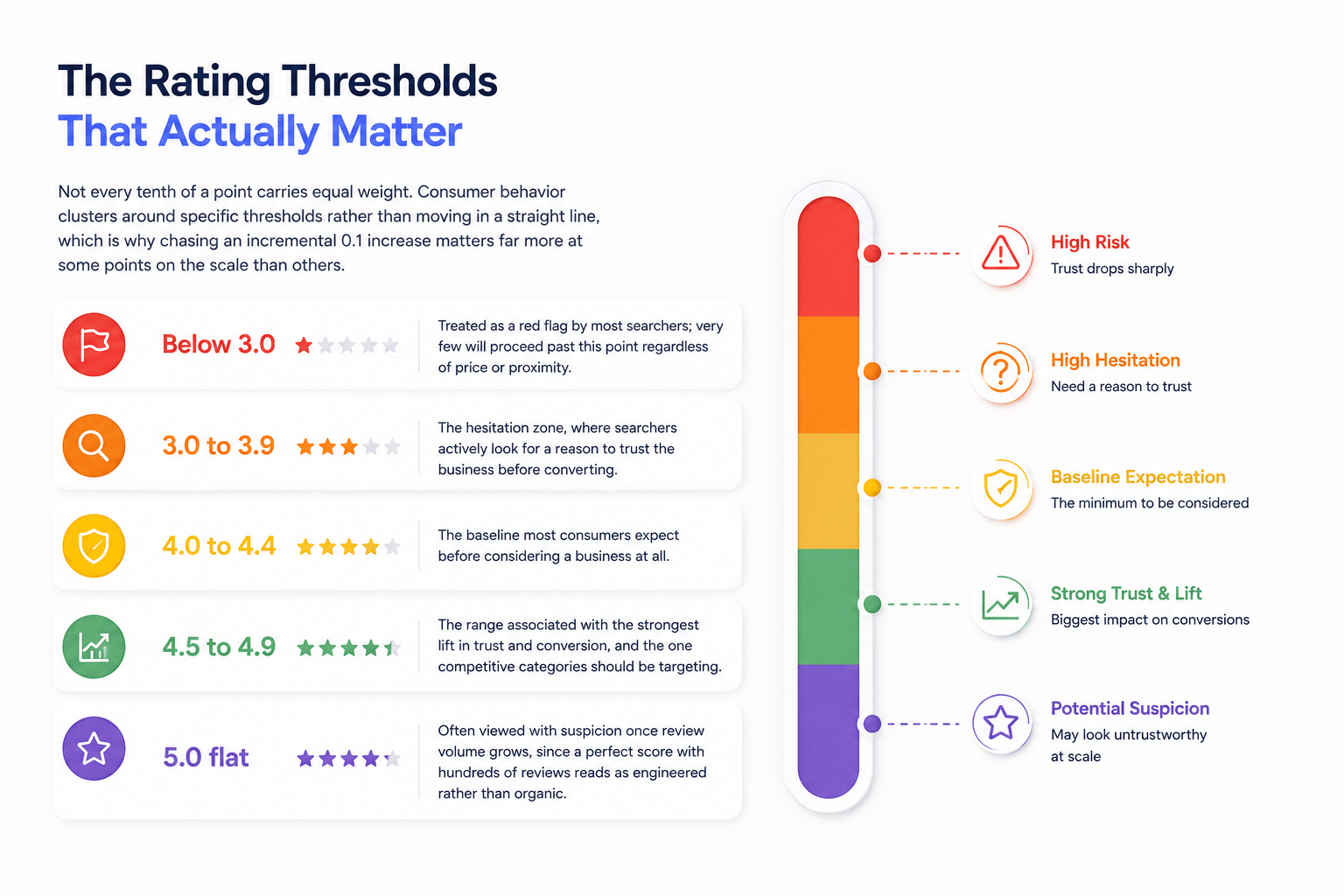
- Below 3.0 — treated as a red flag by most searchers; very few will proceed past this point regardless of price or proximity.
- 3.0 to 3.9 — the hesitation zone, where searchers actively look for a reason to trust the business before converting.
- 4.0 to 4.4 — the baseline most consumers expect before considering a business at all.
- 4.5 to 4.9 — the range associated with the strongest lift in trust and conversion, and the one competitive categories should be targeting.
- 5.0 flat — often viewed with suspicion once review volume grows, since a perfect score with hundreds of reviews reads as engineered rather than organic.
How a Low Google Rating Quietly Erodes Revenue
The damage from a weak rating rarely shows up as a single dramatic drop — it shows up as a slow leak across every stage of the funnel. Fewer impressions convert to clicks, fewer clicks convert to calls, and the businesses that do convert often negotiate harder on price because trust wasn’t fully established before contact. Multi-location brands feel this compounding effect even more acutely, since one underperforming location’s rating can shape perception of the entire brand in a searcher’s mind before they’ve interacted with any other branch.
Building a Rating Recovery and Growth System
Because the rating is a rolling average, recovery is mathematical rather than magical — a steady stream of new positive reviews gradually dilutes the weight of older negative ones. The foundation of that system starts with get more Google reviews consistently, which covers the request timing and channels that produce the highest response rates without violating Google’s review policies.
Review generation alone isn’t enough. Businesses that pair new review volume with visible engagement — respond to Google reviews the right way — consistently outperform those that let reviews sit unanswered, because response behavior itself functions as a trust signal independent of the numeric score.
Monitoring and Protecting Your Google Rating Long-Term
Rating protection is an ongoing discipline, not a one-time cleanup. When a negative review does land, the approach matters more than the reaction speed alone — handling negative Google reviews walks through de-escalation language that limits reputational damage without appearing defensive.
Businesses expanding into secondary locations or adjacent service areas should also revisit local SEO fundamentals and how Google ranks local search results, since rating strength only compounds into rankings when the underlying profile and on-site signals are equally solid.
| Takeaway Google rating business impact isn’t confined to reputation — it’s a measurable input into click-through rate, conversion rate, and local prominence. Businesses that manage it as a growth lever, not an afterthought, consistently outrank and outconvert those that don’t. |
Frequently Asked Questions
1. What is considered a good Google rating for a business?
Most consumers treat 4.0 as the minimum acceptable threshold, but 4.5 and above is where the strongest lift in click-through and conversion behavior appears. A rating sitting between 4.2 and 4.7 is generally read as both excellent and believable, since a flawless 5.0 can raise suspicion once review volume grows.
2. Does Google rating business impact actually affect search rankings, not just clicks?
Yes, indirectly. Google’s local ranking system weighs relevance, distance, and prominence, and review signals (rating, volume, and recency) feed directly into prominence. A stronger rating won’t override a broken NAP profile or thin listing, but it consistently correlates with better local pack visibility when paired with solid on-profile optimization.
3. How often does Google update a business’s star rating?
Google recalculates the review score continuously, but a newly submitted review can take up to two weeks to be reflected in the visible average. This lag is why a single bad week rarely tanks a rating overnight, and why consistent review requests matter more than one-off pushes.
4. Can a low Google rating be fixed, or is the damage permanent?
It can be improved. Because the rating is a rolling average, a steady stream of new positive reviews gradually dilutes older negative ones. Businesses recovering from a poor score typically pair review-generation campaigns with visible, professional responses to past negative feedback to rebuild trust signals.
5. Does responding to reviews influence the star rating itself?
Responding doesn’t change the mathematical average, but it shapes how prospective customers interpret the number next to it. A business with a 4.2 rating and thoughtful responses often outperforms a 4.6 rating with no owner engagement, because response behavior signals active reputation management.
6. How many reviews does a business need before the rating feels trustworthy?
Consumer research consistently shows a credibility floor around 20 reviews — below that, shoppers tend to discount the rating as too small a sample. There’s also an upper comfort zone; extremely high volumes with no negative reviews can look engineered rather than organic.
7. What’s the fastest way to improve Google rating business impact for a struggling profile?
Prioritize three moves in order: fix any operational issue driving repeat negative feedback, build a simple post-service review request workflow, and respond to every existing review — positive and negative — within 48 hours. Rating recovery is a volume-and-consistency problem, not a one-time fix.

No responses yet